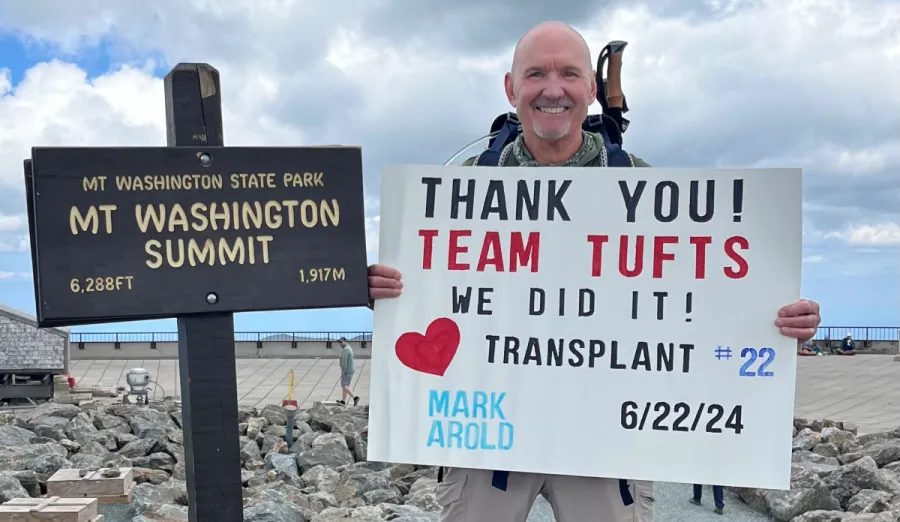
When former UPS pilot Mark Arold, 64, reached the top of Mount Washington in August 2025—just 14 months after receiving a new heart and kidney at Tufts Medical Center—he carried a handwritten sign that read: “We Did It.”
For Mark, it was more than a personal victory. It was a tribute to the team that gave him a second chance at life.
“I’ve been in a lot of hospitals, but Tufts Medical Center was different,” he said. “Everyone was in sync, focused and invested in helping me get better. They’re just incredible people.”
A lifetime of heart challenges
Mark’s story began decades earlier. He suffered a heart attack at 42 and required double bypass surgery. Years later, his aortic valve began to fail, leading to a TAVR procedure and the implantation of a defibrillator.
Despite each procedure, his heart function continued to decline. Eventually, he developed congestive heart failure and stage 4 kidney disease, forcing him to retire from the cockpit.
Heart disease had already shaped his life. His father died of a heart attack at 34, when Mark was just 11. “There’s definitely a hereditary component,” he said. “It’s been part of my life for as long as I can remember.”
As his health worsened, he lost the ability to enjoy the outdoors—something central to who he is. “I love hunting, fishing, camping and hiking,” he said. “But when you’re in heart failure, that’s off the table. I couldn’t hike for at least seven years.”
A new beginning at Tufts Medical Center
When his doctors in New Hampshire referred him to Tufts Medical Center, Mark knew it was his best hope. He was placed on the waitlist for a combined heart and kidney transplant in April 2024. Just two months later, he got the call.
Mark’s transplants were truly a team effort. On June 22, 2024, Heart Transplant Surgeon Aaron Sparks, DO, performed his heart transplant, followed the next day by a kidney transplant performed by surgeons Despoina Deskalaki, MD, and Manish Varma, MD. Throughout his journey, his heart failure and transplant cardiology care team, led by Michael Kiernan, MD, and Rachel Clarke, RN, MSN, AGACNP-BC, guided and supported him every step of the way.
From the very first moments, Mark sensed the difference. “I’ve spent time in a lot of hospitals over the years, and this was by far the best experience I’ve ever had,” he said. “The care, the coordination, the communication—it was all exceptional.”
Recovery came quickly. Mark was surprised by how manageable his pain was. “After everything I’d been through before, I expected it to be tough,” he said. “But I went from ICU meds to just Tylenol. It was unbelievable.”
Mark credits the Tufts Medical Center team approach for his rapid progress. From surgeons and nurses to cardiology specialists to transplant coordinators, techs, physician’s assistants and physical therapists, “everyone knew what was happening and worked together,” he said. “You could feel that teamwork. It wasn’t just the procedures—it was how much they cared.”
A goal set in the ICU
While still in the ICU, Mark made a promise to his wife Karen and family that he would climb Mount Washington again, a mountain he had summited several times in his younger years.
“This goal became my motivation,” he said.
Once he was cleared, Mark began cardiac rehabilitation and later worked with a personal trainer to rebuild his endurance. By April 2025, he was hiking regularly again.
Reaching the summit
In August 2025, Mark kept his promise. Fourteen months after his transplants, he hiked Mount Washington with his son Max, daughter-in-law Madeleine and two longtime friends.
“When I reached the summit, my feet were sore,” he said, “but cardio wasn’t an issue whatsoever.”
At the top, he held up his ‘We Did It’ sign—an expression of gratitude for every person who helped him get there.
Gratitude and determination
Today, Mark stays active and focused on the future. “I have my life back,” he said. “I owe that to the skill and dedication of the team at Tufts Medical Center, the incredible generosity of my donor and their family and the unwavering support of my wife and family.”
Mark continues to hike, train and set new goals. “I can still do more and be better,” he said. “I didn’t know my limitations, but I set out to find them. I’m not done.”