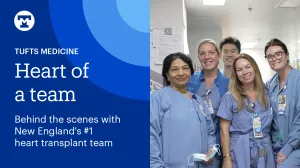
Flashback to 1985: Back to the Future ruled the box office, Whitney Houston’s “Saving All My Love for You” was playing on Walkmans and clunky cordless phones were the peak of tech innovation. While big hair and neon fashion had their moment, something even bigger was happening in Boston—Tufts Medical Center launched a heart transplant program that would go on to change lives, set records and become the gold standard in New England.
Forty years later, Tufts Medical Center is home to New England’s top heart transplant program, performing up to 70 transplants a year and ranking 13th in the nation by volume in 2024. But behind those numbers is a story of vision, dedication and a care model that’s transforming how advanced heart failure is treated across the Northeast.
From the beginning, Tufts Medical Center set out to build more than just a surgical program. The goal was to support patients beyond the operating room and in their communities and across every stage of care.
Transplant cardiologist, Marvin Konstam, MD, who co-founded the heart transplant program at Tufts Medical Center, recalls the challenges of launching such a complex and high-stakes initiative. “There was a tremendous learning curve in both surgery and medicine,” says Dr. Konstam, now Chief Physician Executive Emeritus of the CardioVascular Center at Tufts Medical Center. “We had to learn how to use new immunosuppressive drugs, master advanced surgical techniques and closely monitor and manage cardiac rejection. But the greatest challenge was an ethical one—deciding who would receive such a precious and limited resource. We had to learn to offer hearts only to patients with both the greatest need and the highest likelihood of short- and long-term success. The fact that we now perform the number of heart transplants we can, is a powerful reflection of the dedication, innovation and compassion our team has brought to this work over the years.”
How has the Tufts Medical Center team built the number one program in the region? They don’t wait for hearts to come to them, it’s a result of building strong referral networks, maintaining continuous communication, supporting community-based clinicians and ensuring patients receive exceptional care no matter where they live. As transplant volume has nearly doubled in recent years, the team has expanded significantly, adding new heart failure specialists and growing both inpatient and outpatient capacity.
“We’ve developed a shared care model through partnerships with cardiologists and primary care doctors across the region,” says David DeNofrio, MD, long-time Director of Advanced Heart Failure Program and current Director of Heart Failure Network Development. “It’s a win-win. Patients stay connected to their local care teams, and community doctors get the support they need to manage complex cases.”
Trust is also at the heart of the program’s success. With up to 200 transplant evaluations each year, a coordinated approach is essential to managing patient experience and keeping referring doctors closely involved.
“At the heart of our success is trust,” says Michael Kiernan, MD, Associate Chief of Cardiology at Tufts Medical Center. “Trust between patients and clinicians, among our multidisciplinary team and with referring partners across the region. These relationships have helped make us a center of excellence. Our outcomes reflect not just surgical expertise but true partnership and commitment to every person we care for.”
Innovation has played a major role in expanding access to donor hearts. One key development is the routine acceptance of hepatitis C-positive organs. Thanks to new antiviral treatments, Tufts Medical Center can safely transplant these hearts into hepatitis C-negative recipients and treat the virus post-surgery, opening a new pool of viable donors.
Another breakthrough is the adoption of donation after circulatory death (DCD). Using machine perfusion, the team resuscitates and preserves hearts from donors who have experienced cardiac arrest, keeping them viable for up to 12 hours. This allows the team to travel farther and has increased available donor hearts by up to 50 percent.
“A key driver of our growth has been the way we harness advanced technologies in perfusion, organ preservation, and long-range logistics,” said Sharon Klarman, Associate Vice President of Transplant Services at Tufts Medicine. “Our team travels as far as 3,500 nautical miles to recover donor hearts, an expanded reach that allows us to increase transplant volume, shorten wait times and bring lifesaving care to more patients. At Tufts Medical Center, we are steadfast in our commitment to ensuring that every viable heart finds its home.”
What began in 1985 as a bold new initiative has grown into a lifeline for hundreds of families and a national leader in heart transplantation. From surgical innovation to community collaboration, Tufts Medical Center continues to lead the way through connection, compassion and a long-term commitment to care.