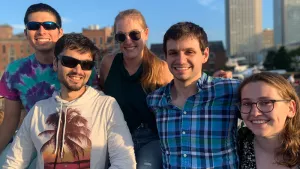
Meet the experts shaping the future of endocrinology

Our Division is home to a dedicated team of faculty, fellows and staff who share a deep commitment to clinical care, education and innovation. Faculty members are nationally recognized leaders in endocrinology and serve as mentors, collaborators and role models. Fellows thrive in a collegial, mission-driven environment where patient care and learning go hand in hand.

Endo 2023
Display title
Our People
Eyebrow
Endocrinology Fellowship Program

Inside our endocrinology fellowship program

The Endocrinology Fellowship Program at Tufts Medical Center provides a strong, hands-on clinical experience for physicians who want to specialize in endocrine and metabolic disorders. Our fellows care for adults with a wide range of conditions—from common diagnoses to rare and complex cases—both in the hospital and in outpatient clinics.

Training is structured to build confidence and clinical judgment over time. Fellows follow patients in longitudinal clinics and manage diverse levels of acuity, preparing them for independent practice. We emphasize critical thinking, evidence-based care and thoughtful reflection to help fellows grow as skilled, compassionate endocrinologists.

Clinical programs + services

  • Bone and Mineral Disorders
  • Thyroid Disease & Procedures (incl. Fine Needle Aspiration & Ultrasound)
  • Neuroendocrinology & Pituitary Disease
  • Diabetes and Lipid Disorders
  • Weight Management and Nutrition
  • Glycemia Consultation Service
  • Fracture Liaison Service

Community practice locations

  • Tufts Medical Center – Quincy
  • Tufts Medical Center – Norfolk
  • Tufts Medical Center – Framingham
  • Tufts Medicine Weight + Wellness – Boston + Stoneham
Endo 2023
Display title
Training Experience
Eyebrow
Endocrinology Fellowship Program

Decades of leadership in endocrinology fellowship training

1940s – Dr. Edwin B. Astwood

Dr. Astwood became the first Chief of the Division of Endocrinology. He led groundbreaking research, including the introduction of medications for hyperthyroidism, the isolation and preparation of ACTH for clinical use, and the purification of human growth hormone. These discoveries led to the first effective treatment for pituitary dwarfism.

1972 – Dr. Seymour Reichlin

A world-renowned leader in neuroendocrinology, Dr. Reichlin succeeded Dr. Astwood. His team developed the first radioimmunoassay for thyrotropin-releasing hormone and helped define the sequences of pre-pro somatostatin and pre-pro thyrotropin-releasing hormone. His work advanced our understanding of the role the immune system plays in neuroendocrine regulation. He also led progress in the evaluation and treatment of hyperprolactinemia and early diagnosis and treatment of MEN II syndrome. During this time, the construction of the Human Nutrition Research Center on Aging next to Tufts Medical Center further strengthened the division’s research in lipid metabolism, calcium metabolism and obesity.

1990 – Dr. A.E. Boyd, III

Dr. Boyd brought deep expertise in diabetes and molecular biology. Under his leadership, the Division entered a period of rapid growth. To support its expanding faculty and research programs, the Division moved into a newly renovated, 15,000-square-foot research facility adjacent to the hospital.

1995 – Dr. Ronald M. Lechan

After Dr. Boyd’s passing, Dr. Lechan—who had been a faculty member since 1981—was appointed Chief. He launched specialized programs in hypothalamic and pituitary disease and adrenal neoplasia, earning Tufts Medical Center designation as a Clinical Center for Pheochromocytoma-Paraganglioma by the Pheo-Para Alliance. He expanded community clinical care by opening satellite centers in Quincy and Norfolk. Dr. Lechan also founded and nurtured the Friedman Fellowship Program in Diabetes and Metabolism, supported by the Dr. Gerald J. and Dorothy R. Friedman NY Foundation for Medical Research. He served as Fellowship Program Director from 1995 to 2022.

2020 – Dr. Anastassios G. Pittas

A faculty member since 2000 and the first Friedman Fellow (2000–2002), Dr. Pittas became Chief in December 2020. He was named Fellowship Program Director in 2022. Under his leadership, the program continues to grow through academic excellence, strong community partnerships and dedicated faculty development. Today, the program remains rooted in its core values—clinical rigor, intellectual curiosity and humanistic care—while evolving to meet the needs of a changing healthcare landscape.

Display title
Program History
Eyebrow
Endocrinology Fellowship Program

What makes the Tufts Medical Center Endocrinology Fellowship unique?

Dear applicant,

Anastassios Pittas

The Fellowship Program in Endocrinology in the Division of Endocrinology, Diabetes and Metabolism at Tufts Medical Center aims to bestow fellows with the knowledge, skills and adaptive expertise required to become independent consultants in endocrinology.

The Program nurtures a belonging environment that values wellness and allows fellows to receive training that aligns with established knowledge and methods towards high-quality, high-value and patient-centered care that celebrates individuality. We embrace thoughtfulness, forward-thinking and imagination to prepare fellows for rapidly evolving knowledge and methods in the field of endocrinology. The Program is tailored to meet the needs of fellows whose future focus with be clinical practice, those who wish to become clinician-educators and those who want to pursue careers in endocrine research.  

We look forward to your visit to meet with faculty and current fellows and learn more about the program. 

Be well. Be kind. Reach out. 
   
Anastassios G. Pittas, MD, MD 
Professor of Medicine  
Division Chief, Endocrinology, Diabetes and Metabolism
Program Director, Endocrinology Fellowship Program

Display title
Message from Program Director
Eyebrow
Endocrinology Fellowship Program

Endocrinology Fellowship goals

Our faculty is dedicated to ensuring that fellows leave the program with the knowledge, skills, attitude and experience to excel in the field of endocrinology and metabolism. These objectives ensure fellows are well-prepared for careers in clinical practice, medical education or clinical research. In this fellowship, trainees will learn how to:

endo faculty indoors
Display title
About Our Program
Eyebrow
Endocrinology Fellowship Program
Jump back to top