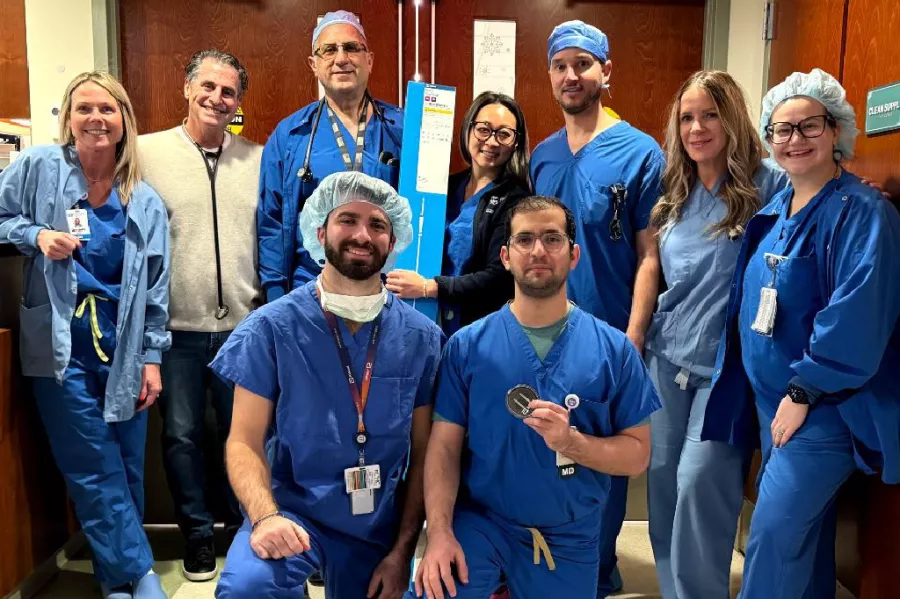
MelroseWakefield Hospital announced that it is the first community hospital in Massachusetts to successfully implant an AVEIR AR Atrial Leadless Pacemaker during a procedure in the hospital’s cardiac catheterization lab. Jennifer Chee, MD, Director of the Ventricular Arrhythmia Program at Tufts Medical Center and electrophysiologist at MelroseWakefield Hospital, performed the procedure.
Pacemakers are small, battery-powered devices that “listen” to your heart. If it is beating properly, the pacemaker does nothing. But when your heart is beating too slowly, the pacemaker sends tiny electrical signals to get your heart rhythm within your normal range.
Unlike traditional pacemakers, leadless devices are implanted directly into the heart through a minimally invasive procedure, eliminating the need for cardiac leads. As a result, leadless pacemakers reduce people’s exposure to potential lead- and pocket-related complications while offering a less restrictive and shorter recovery period post-implantation.
According to Dr. Chee, the additional benefits of this particular device include lower risk of infections, elimination of visible scarring and lack of arm restrictions, which make this an ideal option for people who are athletes or have active lifestyles.
Smaller than a AAA battery, AVEIR AR Atrial LP attaches to the heart’s interior wall with a screw-in mechanism known as a helix. This unique feature allows for the leadless pacemaker to be retrieved should therapy needs evolve or if the device needs to be replaced in the future. Through real-time mapping capabilities, physicians can assess the proper placement of AVEIR AR Atrial LP before fixation.
The implantation of the leadless atrial pacemaker is another of a series of important milestones for the MelroseWakefield Hospital Cardiovascular Center, which treated a coronary artery disease patient using a drug-coated balloon this past September. MelroseWakefield Hospital is nationally recognized for its cardiac and heart care, having been acknowledged by U.S. News and World Report as High Performing in Heart Failure. The hospital is also one of only a handful of community hospitals across Massachusetts to be licensed to operate a cardiac catheterization lab, where life-saving treatments and procedures are performed routinely.