Interventional cardiology uses catheters to treat heart and blood vessel conditions like coronary artery disease, valvular heart disease and cardiac defects. This minimally invasive approach allows people to get lifesaving heart procedures without needing open-heart surgery.
Interventional Cardiology
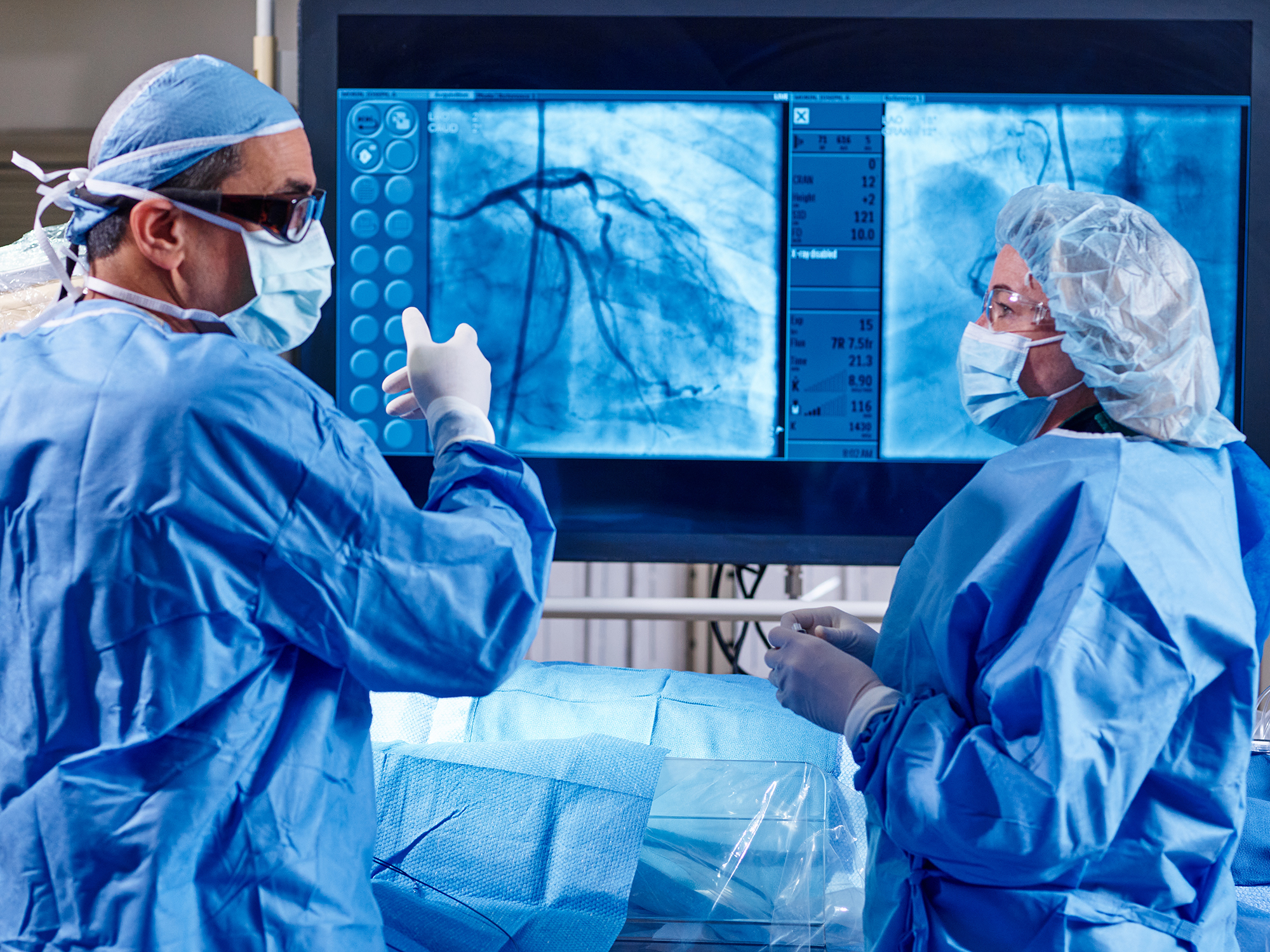


Revolutionizing heart care with interventional cardiology
You don’t always need major surgery to treat serious heart problems. Many conditions can be fixed with catheters, thin tubes smaller than a piece of spaghetti.
These treatments are less invasive than open-heart surgery, meaning smaller cuts, less pain and faster recovery. They can improve blood flow, repair holes in the heart, place lifesaving devices like stents or valves, and reduce the risk of heart attack or stroke. These procedures are ideal for people who need effective treatment but want to avoid the long recovery of traditional surgery.
Find a doctor near me

Conditions
Interventional cardiology offers minimally invasive treatments to manage these conditions and help you feel better faster. You might benefit from interventional cardiology if you have one or more of these heart conditions:
Aortic aneurysm
Atrial fibrillation
Cardiac arrhythmia
Congenital heart defects
Coronary artery disease
Heart attack
Hypertrophic cardiomyopathy (HCM)
Mitral valve regurgitation
Peripheral arterial disease
Valvular heart disease

Testing
Interventional cardiology focuses on keeping your blood flowing properly in and out of your heart. We check for blockages that could stop healthy blood flow and look for irregular heart rhythms. To diagnose heart conditions, we use a variety of tests, including:
- Cardiac MRI
- CT scan
- Echocardiogram
- X-ray of the chest
Cath lab
A cath lab, short for a catheterization laboratory, is a specialized room with advanced equipment for testing heart and blood vessel conditions. Your doctor may send you to the cath lab for procedures like right heart catheterization. This minimally invasive test uses a catheter to check how well your heart is pumping.

Treatments
Interventional cardiology offers advanced, minimally invasive treatments for heart and blood vessel problems. Using small, flexible tubes called catheters, doctors can fix blockages, repair heart valves and treat heart defects without open-heart surgery. This way, patients recover faster, feel less pain and have fewer risks than with traditional surgery. Our expert team leads the way in these treatments, providing solutions that help improve heart health with less disruption to your life. As one of the first in New England to treat hypertrophic cardiomyopathy with alcohol septal ablation, we are committed to leading the way in both interventional cardiology and your heart care.
Your interventional cardiology care will be personalized to your needs, but we offer a full range of catheter-based procedures and surgeries, including:
- Alcohol septal ablation: Used to treat hypertrophic cardiomyopathy, where the heart muscle becomes abnormally thick, making it harder for the heart to pump blood. A small amount of alcohol is injected into a specific artery to shrink the heart muscle, reducing thickness and improving blood flow.
- Catheter ablation for atrial fibrillation: A procedure where a catheter is inserted into the heart to destroy small areas of tissue causing irregular heartbeats. This helps restore normal rhythm and reduce the risk of complications like stroke.
- Heart catheterization: A procedure where a catheter is inserted into a blood vessel and guided to the heart to check heart and blood vessel health. It helps diagnose heart problems like blockages or coronary artery disease, measure heart pressure and take X-ray images.
- Patent foramen ovale (PFO) closure: Treats a small hole in the heart that is present at birth but may not close naturally. If left open, it can increase the risk of stroke later in life.
- Transcatheter aortic valve replacement (TAVR): Replaces diseased heart valves through a non-surgical procedure. This is ideal for patients who can't have open-heart surgery and helps improve heart function.
- TMVR with MitraClip™: A non-surgical treatment for a leaky heart valve. A catheter is used to place the MitraClip™ to help the valve close tightly and improve blood flow.
- Ventricular assist device (VAD): A mechanical pump used when the heart struggles to pump blood effectively. It helps the heart’s lower chambers pump blood to the rest of the body, improving heart failure outcomes.
- WATCHMAN™ device: Reduces stroke risk by closing the left atrial appendage to prevent blood clots from escaping. It eliminates the need for long-term blood thinners like Warfarin, reducing bleeding risks and the need for regular blood tests.
With these innovative, life-changing treatments, we’re here to support your heart health every step of the way.
I knew I was in expert hands, the cardiac cath team acted immediately, getting me from ambulance to lab in one hour.
Lowell General Hospital

Everyone has a purpose—I neglected my health, but Dr. Daly’s team saved my life, gave me a second chance and renewed purpose.
MelroseWakefield Hospital

FAQs
What are the risks of implanting the WATCHMAN™ device?
The WATCHMAN™ device is a permanent implant designed to close your heart's left atrial appendage (LAA) to reduce the risk of stroke.
There are risks associated with all medical procedures and implanting the WATCHMAN™ device is no exception. The risks include but are not limited to:
- Accidental heart puncture
- Air embolism
- Allergic reaction
- Anemia
- Anesthesia risks
- Arrhythmias
- AV (arteriovenous) fistula
- Bleeding or throat pain from the TEE (transesophageal echo) probe
- Blood clot or air bubbles in the lungs or other organs
- Bruising at the catheter insertion site
- Clot formation on the WATCHMAN™ closure device
- Cranial bleeding
- Excessive bleeding
- Gastrointestinal bleeding
- Groin puncture bleed
- Hypotension
- Infection/pneumonia
- Pneumothorax
- Pulmonary edema
- Pulmonary vein obstruction
- Renal failure
- Stroke
- Thrombosis
- Transient ischemic attack
In rare cases death can occur. Be sure to talk with your doctor so that you thoroughly understand all of the risks and benefits associated with a WATCHMAN™ implantation.
Related services + treatments

CardioVascular Center
Academic Department
Our cardiovascular specialists combine expertise across cardiology, cardiac surgery and vascular medicine to advance cardiovascular care through innovation, collaboration and training, improving the lives of patients with complex heart and vascular disease.
Clinical trials
A multicenter trial assessing the impact of lipoprotein(a) lowering with pelacarsen (TQJ230) on the progression of calcific aortic valve stenosis

Aortic stenosis
All genders
50+

Recruiting now