Michael Conti is a Social Work Coordinator at Tufts Medical Center. In the reflection below, he shares his personal experience attending his first honor walk—a ceremony that honors patients who have chosen to give the gift of organ donation while recognizing the profound loss their families are experiencing. Through his own perspective, Michael reflects on the compassion, dignity and quiet moments of connection that make this tradition so meaningful for patients, families and the caregivers privileged to stand alongside them.
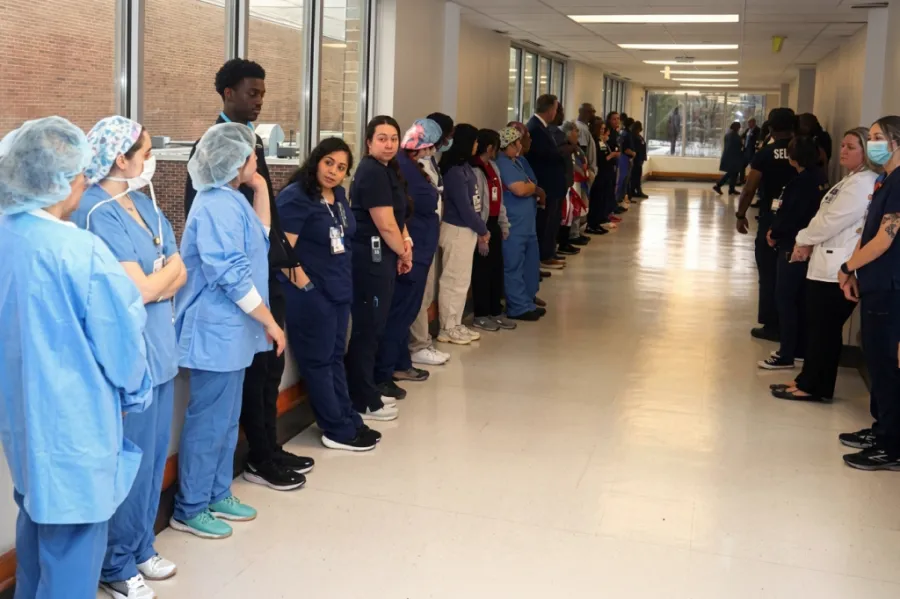
I almost missed it entirely. When a colleague reached out to invite our department, I found myself stepping off the elevator to find small battery-operated candles quietly being passed around by staff. The hallway was already filling around us. Clinicians, nurses, support staff were all pausing from their day. Something significant was about to happen.
I'll be honest, I first encountered an honor walk on Grey's Anatomy. Yes, I watch Grey's Anatomy. Please don't judge me. Even through the TV screen it made me tear up, and I remember thinking, is this something that actually happens? It is. And nothing on television comes close to the real thing.
For those who haven't seen one, an honor walk—sometimes called a hero walk or walk of respect—is a ceremonial procession held when a patient who has chosen organ donation is transported to the OR. Staff, and sometimes patients, line the hallway in quiet tribute as the donor and their family make that final journey. The tradition grew from nurses and care teams in ICUs who wanted a meaningful way to honor patients who had chosen donation after death.
One of the most well-known early adoptions came from the University of Vermont Medical Center, where an organ donation coordinator saw a photograph of the ritual at another hospital and brought the idea to leadership. Approval came on the spot. From there, it spread—because it fills a need that is deeply human. Today, with over 100,000 people on the national transplant waiting list and a single donor able to save up to eight lives, the honor walk exists to make sure that gift, and the person behind it, is never taken for granted.
What I wasn't prepared for was looking down that hallway and seeing patients standing there too, candles in hand, in quiet solidarity with the rest of us. In that moment, the line between caregiver and patient disappeared. We were just people, together, honoring another person.
And then the family came. Some were sobbing. The weight they were carrying was visible in every step. I focused on holding my candle steady, because that felt like the one thing I could offer them in that moment. By the time it was over, I wasn't the only one wiping my eyes. This was one of the most profound moments of my time at Tufts Medical Center.
I want to thank Tufts Medical Center clinical social workers Elyse McCue, LICSW, Prutha Patel, LICSW and the entire social work team, spiritual team, doctors, nurses and everyone who supports transplant families every day. You sit with people through some of the hardest moments of their lives, and you do it with a grace the rest of us can only aspire to.
I am an organ donor. Standing in that hallway, watching that family walk by, I thought about my own family. And I can only hope that when my time comes—when it's my honor walk—they will look down a hallway lined with people holding candles and know, truly know, that they are not alone.
If you've never participated in an honor walk, say yes the next time you're invited. You don't need to say or do anything. Just show up, hold your candle and stand in the hallway. That’s enough. For the grieving family walking past you in the hardest moment of their lives, it is everything.
At Tufts Medical Center, every organ donation is honored with compassion, dignity and expert care. Our team works closely with donors, recipients and families throughout every step of the organ donation journey, helping turn the gift of life into hope for those waiting for a second chance.
Visit New England Donor Services to learn how to register as an organ donor.