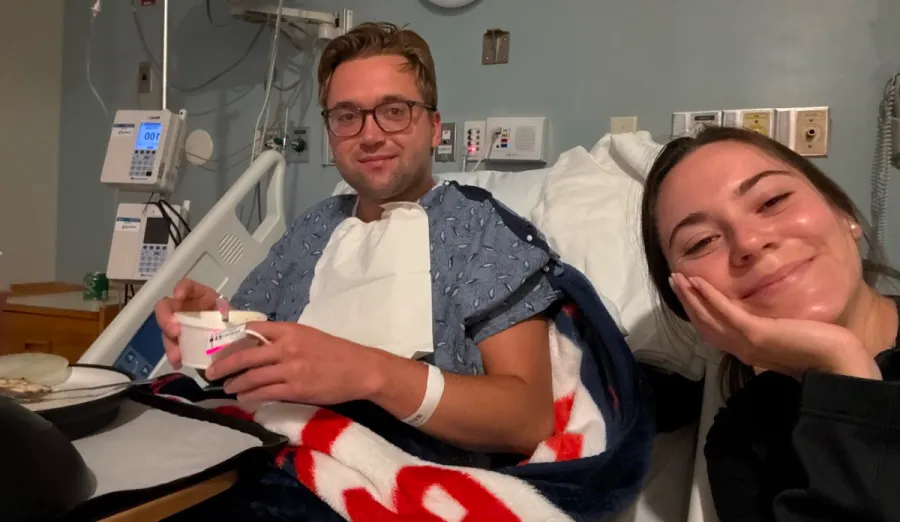
At 29, Chris Jaquith was in great shape. He worked out regularly, stayed active and felt strong. So when sudden nausea, vomiting and a loss of coordination hit him out of nowhere, he knew that something was seriously wrong.
On August 27, 2025, Chris arrived at the Emergency Department at Tufts Medical Center where a CT scan revealed he was having a stroke. He was admitted quickly and his care team began searching for the cause.
Uncovering the culprit
Sarah Nelson, MD, MPH, Stroke Director at MelroseWakefield Hospital, was supervising the inpatient Stroke Service and soon identified a critical clue: Chris had a patent foramen ovale (PFO), a small opening between the heart's upper chambers that should close shortly after birth. About one in four adults have a PFO and most never experience symptoms. But in some cases, a clot can pass through the opening and travel to the brain. Determining whether Chris's PFO was truly the culprit would guide every decision that followed.
David Thaler, MD, PhD, an internationally recognized PFO thought leader, explains, "A PFO can be the underlying cause of a stroke in young otherwise healthy adults. Our role is to determine whether it's responsible so we can pursue the right treatment."
Once it was confirmed that the PFO had caused Chris's stroke, the baton passed to cardiologist Carey Kimmelstiel, MD, Director of the Interventional Cardiology Center. His job: determine the best way to close the hole and perform the procedure.
A groundbreaking option
With the cause identified, the team outlined Chris's options: one of two FDA-approved closure devices or participation in a first-in-human clinical trial testing a new device that was available only at Tufts Medical Center.
"This new device is designed to straddle the septum with discs on both sides, allowing tissue to grow over it," Dr. Kimmelstiel says. "Its innovative material lets us safely navigate the heart in the future without compromising the device. It's a groundbreaking solution for patients at risk of stroke."
The device offers two key advantages: it allows future cardiac procedures to pass through the heart more easily and it leaves behind less material, potentially lowering the risk of atrial fibrillation.
For Chris and his family, the choice was clear.
Making history
On October 9, 2025, Chris became the first person in the world to receive the new PFO closure device. Tufts Medical Center was the first site to enroll a patient in this groundbreaking study, and Dr. Kimmelstiel completed the procedure successfully.
Everything went smoothly. Chris went home the same day, walked a mile the next and has continued to feel great. Today, he's preparing to run the 2026 Boston Marathon as part of Team Tufts MC.
Running toward the finish line
"As my recovery progressed, I decided that I wanted to direct my energy into turning this negative event into a positive by saying thank you and giving back to the people and hospital that saved my life," said Chris. "I can think of nothing better than running the 2026 Boston Marathon and fundraising for Tufts MC, while also spreading awareness about PFOs and strokes in young people, and the importance of neuro and cardio health, to try to help others who may be in a similar situation."
Chris's story has already begun reaching others. Local news station WCVB recently featured him for the second time, this time focusing on his marathon journey.
In the months since his procedure, follow-up appointments have confirmed the device is working perfectly. While Chris initially lost some coordination on his right side, 10 weeks of physical therapy helped him make a complete recovery. Now, he's focused on race day.
"When I cross the finish line on April 20, it will be the closure of an unforeseen chapter of my life on my terms."
Chris Jaquith