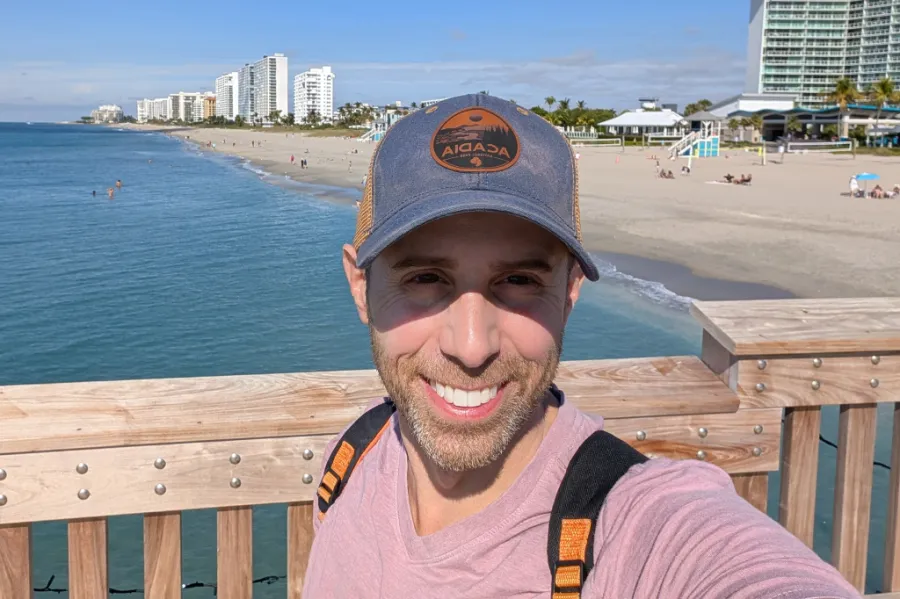
The 45-year-old Concord, Massachusetts resident had once defined himself by movement. He snowboarded and hiked in the White Mountains, practiced martial arts, lifted weights and biked around Boston. But beginning in 2018, persistent pain in his hip, abdomen and groin slowly took those activities, and much more, away.
“I went from being very, very active to being almost completely inactive,” Bryan recalls. “I couldn’t swing a golf club. I couldn’t snowboard. Some days I couldn’t even get off the floor.”
The pain arrived during a period of major life change. Over the next several years, Bryan and his wife welcomed two children. He changed jobs several times, including founding a tech startup in Boston. But despite those milestones, pain shaped nearly every part of daily life.
“I remember lying on the floor while my daughter was learning to crawl,” he says. “She’d use me to pull herself up, and I’d say, ‘I’m sorry—I can’t get up today.’”
A long search for answers
Bryan spent years trying to understand what was happening. He estimates he saw more than two dozen specialists and attended hundreds of medical appointments.
“I had a spreadsheet of every doctor I’d seen,” he says. “Neurologists, gastroenterologists, infectious disease specialists, surgeons—you name it.”
At one point, he underwent exploratory surgery to see if doctors could identify a physical cause. Imaging and tests often came back inconclusive. The pain persisted.
Even navigating the healthcare system—something Bryan knew well from his previous career designing provider networks for major insurers—proved frustrating.
“If there was anyone who should have been able to navigate the system, it was probably me,” he says. “But most visits were five minutes long. There just wasn’t enough time to tell the full story.”
The impact extended beyond physical discomfort. Chronic pain disrupted his sleep and changed how he showed up for his family and friends.
“People who hadn’t seen me in a while would say, ‘You seem different,’” Bryan says. “Pain can dim your life in ways people don’t always understand.”
A new approach
Bryan’s turning point came through an unexpected connection. A longtime friend who specializes in myofascial therapy and pelvic health listened to his story and suggested he meet with a physician she trusted: Alexandra Adler, MD, MPhil, anesthesiologist and expert in pain management at Lowell General Hospital.
“When I met Dr. Adler, it felt different immediately,” Bryan says. “Instead of just reviewing tests, she wanted to understand my story.”
That conversation—far longer than the typical appointment—helped build a foundation of trust and partnership.
“She asked about everything: my symptoms, my life, how the pain affected my family, how it had evolved over time,” Bryan says. “For the first time, I felt truly heard.”
Learn what to expect at pain management therapy.
A more complete picture of pain
Dr. Adler’s evaluation combined physical investigation with a broader understanding of how chronic pain develops.
Imaging eventually revealed a tear in the labrum of Bryan’s hip that had gone undetected previously. But the years of ongoing pain had also created complex patterns in the body and brain.
“Pain isn’t always just one thing,” Bryan explains. “Your body and brain can get stuck in patterns that keep the pain cycle going.”
Dr. Adler treated Bryan with a targeted nerve block injection to reduce the pain and give him relief. She also recommended a structured pain reprocessing therapy (PRT) program to help retrain how the brain interprets pain signals.
At first, Bryan was skeptical. But with Dr. Adler’s encouragement, and a strong therapeutic connection with a pain coach, he began working through the program.
The combination proved transformative.
Life opens back up
Over the next several months, Bryan experienced dramatic improvement. By learning techniques to reframe pain signals and combining them with physical therapy and body-based strategies, he gradually regained control.
Today, he estimates his symptoms are 95–98 percent improved.
“I still have the occasional flare-up,” he says. “But now I have tools. I know how to manage it.”
The biggest change has been returning to the activities that once felt impossible.
“I remember coming home after treatment and jumping around the house,” Bryan says. “My daughter looked at me and said, ‘Dad, did the doctors fix you?’”
Recently, he bought a new snowboard and returned to the slopes for the first time in years.
“It felt like getting my life back,” he says.
A message for others living with pain
Bryan knows many people with chronic pain struggle to feel understood. His advice for others facing similar challenges is simple.
“First, pain is real,” he says. “Even if tests don’t show everything right away, what you’re feeling is real.”
He also encourages patients to keep searching for the right care team.
“You need partners who will listen to the full story and work with you,” Bryan says. “That’s what made the difference for me.”
Looking back, Bryan credits a network of care—from his physical therapist friend to Dr. Adler and the broader pain management team, for helping him reclaim his life.
“It wasn’t one single fix,” he says. “It was people who listened, believed me and helped me approach the problem from different angles.”
And after years defined by pain, Bryan is once again looking forward to time with his kids, to new adventures and to the simple joy of movement.
“I’m excited to get back out there,” he says. “For the first time in a long time, it feels possible.”