In addition to fundamental discovery, a major objective of the CBRC is to translate these discoveries into novel therapeutic targets to limit the onset and progression of cardiovascular disease. The CBRC maintains a highly collaborative environment with rich areas of cross-pollination with the Vascular Biology Research Center and Center for Translational Pharmacology and Genomics. Strong relationships between the CBRC, the Surgical and Interventional Research Laboratories (SIRL), the Cardiovascular Biobank and the CardioVascular Center have accelerated the translational of several fundamental discoveries into large animal models and subsequently into early-phase clinical trials.
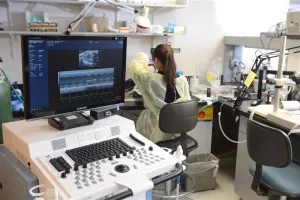
The CBRC employs a wide variety of cutting-edge technology and pioneering techniques to achieve its core mission of fundamental discovery. A central CBRC resource is the Mouse Physiology Core, which conducts advanced hemodynamic studies involving non-surgical univentricular and biventricular pressure-volume loop analysis, electrophysiologic mapping, univentricular and biventricular pacing, 3D and strain imaging echocardiography, murine cardiac magnetic resonance imaging, and isolated Langendorf cardiac preparations. The mouse core also performs multiple models of cardiac injury in mice including thoracic and pulmonary artery banding, pharmacologically induced pulmonary and systemic hypertension, acute myocardial infarction, coronary ischemia-reperfusion injury, renal ischemia-reperfusion injury, unilateral ureteral obstruction, and arterio-vascular shunts.
The CBRC also maintains a rich library of transgenic mouse models for constitutive and inducible manipulation of genetic targets. In collaboration with the SIRL, the CBRC also studies large animal models of coronary ischemia-reperfusion injury and rapid unipolar or bipolar pacing. This unique resource provides investigators with full interventional or cardiac surgical capabilities to study the biological impact of device-based approaches for heart failure including mechanical circulatory support devices. CBRC investigators have also developed techniques for the isolation of atrial and ventricular myocytes, fibroblasts, and Purkinje cells and have expertise in in vitro ischemia-reperfusion injury, cyclic mechanical stretch and strain studies, and single-cell RNA-seq analysis. In summary, the fertile and nurturing environment of the CBRC enables investigators to focus on translating fundamental discoveries into novel therapeutic and diagnostic approaches for millions of individuals suffering from cardiovascular disease worldwide.
CBRC labs
Blanton Laboratory
Robert Blanton, MD
Research Interests: Heart Failure, Cardiomyopathy, Molecular Signaling, cGMP, Protein Kinase G, Cardiac function, Cardiovascular disease, Mixed Lineage Kinase 3
Email: Robert.blanton@tuftsmedicine.org
Chen Laboratory
Howard Chen, PhD
Research Interests: Autophagy, Apoptosis, Molecular Imaging, Theranostic nanoprobes, Cardio-oncology, Cardioprotection, Cardiomyopathy, Heart Failure
Email: Howard.Chen@tuftsmedicine.org
Chin Laboratory
Michael Chin, MD, PhD
Research Interests: Hypertrophic and genetic cardiomyopathies, Barth Syndrome, Heart Failure, Genetics, Genomics, Molecular Biology, Transcriptomics, Proteomics
Email: Michael.T.Chin@tuftsmedicine.org
Galper Laboratory
Jonas Galper, MD, PhD
Research Interests: Metabolic Heart Disease, Impact of Type II Diabetes and Metabolic Syndrome on the Heart, Heart Failure with Preserved Ejection Fraction, Ventricular Tachycardia, Atrial Fibrillation, Ion Channel Dysfunction, Calcium Signaling
Email: Jonas.Galper@tuftsmedicine.org
Kapur Laboratory
Navin Kapur, MD
Research Interests: Heart Failure, Cardiogenic Shock, Cardiac Fibrosis, Heart Failure Device Development, Impact of Circulatory Support Devices on Cardiac Molecular Biology
Email: Navin.K.Kapur@tuftsmedicine.org


 18+
18+


