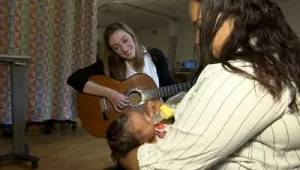
Creating music + memories for healthy moments
Music therapy is a clinical, evidence-based discipline that focuses on the use of music to drive therapeutic change. Our music therapists are board-certified professionals who work with patients to prioritize wellness, promote creative emotional expression, and reduce stress and pain. No musical ability is required to benefit from music therapy.
Sessions occur in one-on-one and group settings in almost every unit of the hospital and can include active music-making, instrument education, songwriting, meditation with music, and live music at the bedside for relaxation and connection to joy.
Common goals of music therapy
- Decreasing pain and nausea
- Reducing anxiety
- Coping with the stress of diagnosis and treatment
- Increasing socialization & meaningful interaction
- Promoting motivation and emotional expression
- Facilitating family bonding
If you are interested in music therapy as a part of your or your loved one’s care while a patient at Tufts Medical Center, please talk to your care team to obtain a referral.
Special areas of focus
Bereavement
Music Therapy can be a support during the most challenging moments you experience with your loved ones at the hospital. Our music therapists assist in memory-making activities, including creating heartbeat recordings and songs. Heartbeat songs are a music therapy intervention that involves recording your loved one’s heartbeat and using it as a rhythmic element in a recording of a preferred song. Our music therapists, per family request, can also participate in your loved one’s end-of-life ceremony. This can often look like the music therapist in the room at time of death providing appropriate instrumental music to hold emotional and spiritual space.
NICU music therapy
In the Neonatal ICU, music therapy collaborates with medical staff to support infants and parents in nurturing development. Our certified NICU MT staff utilize research-based music therapy protocols such as Live Music Listening and Multimodal Neurologic Enhancement. These interventions help to
- Increase tolerance for environmental stimuli
- Decrease stress responses, pain, and discomfort
- Promote bonding and attachment, language development, and stabilization of vitals
- Calm and relax infants and caregivers
Additionally, music therapists assist in creating recordings of parents singing and speaking to their babies to use when they are not in the hospital. These recordings promote bonding, and help soothe the infants.
Neurologic music therapy (NMT)
Neurologic Music Therapy is a branch of music therapy that focuses on the rehabilitation and recovery of cognitive, sensorimotor, and communication deficits due to neurologic injury or disease. Neurologic music therapists are trained in 20 different techniques based on neuroscience research of music perception and production. By utilizing these techniques and adapting them to each individual, music therapy supports recovery and rehabilitation on our neurologic units.
Environmental Musicians Program
Environmental musicians provide mindful musical selections that support the hospital setting. Selections should be positive, relaxing, and neutral, ultimately creating a soothing atmosphere. Environmental musicians, rather than focusing on performance, support the ambiance of the space and the visitors, staff, and patients passing through.
This program is volunteer-based and will be overseen by our Music Therapy Program Manager in coordination with Volunteer Services. Volunteers will be assigned to the atrium/piano area as deemed fit by Music Therapy Program Management.
Volunteer qualifications:
- Advanced musical ability on primary instrument
- Ability to provide music to enhance a positive hospital experience for a duration of at least 30 minutes
- A desire to affect positive change through music
- Understanding the difference between music therapy and environmental music
- A willingness to adapt musical selections based on needs in the surrounding environment
Selections should be:
- No louder than mezzo in volume
- Relaxing, neutral or positive
- Evenly cadenced in rhythmic and melodic qualities
- Should not include contemporary or popular songs
To apply as a volunteer for our Environmental Musicians Program, please email alianora.reilly@tuftsmedicalcenter.org.