The path to Tufts Medicine was anything but ordinary for Dr. Irakli Todua. It spanned continents, disciplines, war and a global pandemic. Yet the thread running through each chapter is his unwavering commitment to people. Today, as a primary care physician, he brings to his work the precision of a cardiologist, the sensitivity of a musician and the resilience of someone who has endured more than most.
Dr. Todua was 3 years old when his life changed abruptly. His family fled violent conflict in his home country, Georgia, by climbing over a mountain range under shelling to reach safety in Russia. His mother was pregnant; their destination was uncertain. The family settled in a borrowed room in Moscow, and although the experience is something he remembers in fragments, its impact is unmistakable.
“We didn’t choose our fate,” he said. “But it shaped who we became.”
Despite hardship, his talents surfaced early. Accepted into the First Moscow State Medical University at just 15 years old, he initially imagined a life in cardiology. He returned to Georgia to complete his cardiology residency at age 19. But while medicine captured his mind, music claimed his heart. He trained rigorously as a classical pianist and later as a vocalist, studying under instructors connected to some of the world’s most renowned musicians. For a time, he considered conservatory training. Ultimately, he chose the sciences, but music has remained a defining part of his identity.
“My mind belongs to science,” he said. “But my heart belongs to music.”
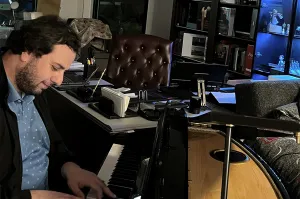
Listen to Dr. Todua perform at the Tufts Medical Center winter concert
After immigrating to the United States, Dr. Todua completed residency in South Brooklyn from 2018 to 2021—a period that became the most emotionally grueling of his life. When COVID-19 swept through New York, he spent more than a month in the Intensive Care Unit (ICU), confronting a scale of loss he still struggles to articulate. He recalls comforting a young man in respiratory failure, holding his hand as he fought for breath. The patient later died, and Dr. Todua delivered the news to the family himself. “That was the moment I knew,” he said. “I couldn’t stay in that world forever. I had given everything.”
The experience shifted his trajectory. Instead of pursuing an inpatient or ICU path, he turned toward primary care and research—areas where he could treat illness earlier and build long-term, meaningful relationships with patients. He traveled across five states to join Tufts Medical Center in 2024. What he found surprised him.
“I could tell immediately the environment wasn’t fake,” he said. “People were genuinely kind, respectful and happy. I had never seen that before.”
For someone who has lived in multiple countries and practiced in diverse systems, Tufts Medicine’s culture of integrity and warmth stood out. Its values, especially One Team, resonated on a personal level.
“One Team means friendship and family,” he said. “It’s the glue—kindness, laughter, helping each other. No job description can create that. No amount of money can create that. It has to be real.”
In the clinic, Dr. Todua is known for careful listening and a methodical, analytical approach. He gravitates toward complex, unsolved cases, including patients whose symptoms have gone unexplained for years. He recalls diagnosing a heart condition that had been missed for two decades, and another patient whose debilitating dizziness and nerve pain gradually improved with proper care and encouragement. The patient had believed she wouldn’t get better, but told Dr. Todua she now has renewed hope.
Medicine is an art. You have to understand the whole person, their body, their mind, their story.
Irakli Todua, MD, a physician-researcher and internal medicine doctor at Tufts Medical Center and Assistant Professor at Tufts University School of Medicine
At Tufts Medicine, Dr. Todua is deeply involved in two cardiovascular research efforts. The first is a project that studies how artificial intelligence can help doctors detect aortic stenosis early. Aortic stenosis is a common and progressive valve disease. The second, in collaboration with the Jonas Galper Lab within the Molecular Cardiology Research Institute (MCRI), focuses on the molecular mechanisms of arrhythmias and heart failure. The group currently has a National Institutes of Health (NIH) grant under review, studying pathways linked to sudden cardiac death — “the holy grail of electrophysiology,” he said.
His academic background makes this work a natural fit. He studied physiology throughout medical school, minored in biophysics and maintains an active interest in molecular biology and quantum biology, even completing online coursework in particle and quantum physics.
“Understanding fundamental mechanisms is why I love medicine,” said Dr. Todua. “Tufts Medicine made it possible for me to study cardiovascular disease at both the molecular and clinical levels. It is a dream I’ve had for years.”
His life outside medicine is as full and layered as his professional one. He still performs classical piano and opera, recently participating in a holiday concert at Tufts Medical Center. He plays near-expert-level chess and collects boards signed by world champions. He cooks elaborate Georgian meals, writes poetry, studies physics and builds intricate models. But the center of his world is his family—his wife and two young children.
In many ways, Dr. Todua’s story is one of contrasts: war and music, science and art, suffering and hope. Yet these make up a physician who leads with empathy, who values excellence and respect and who believes deeply in the power of a unified team.