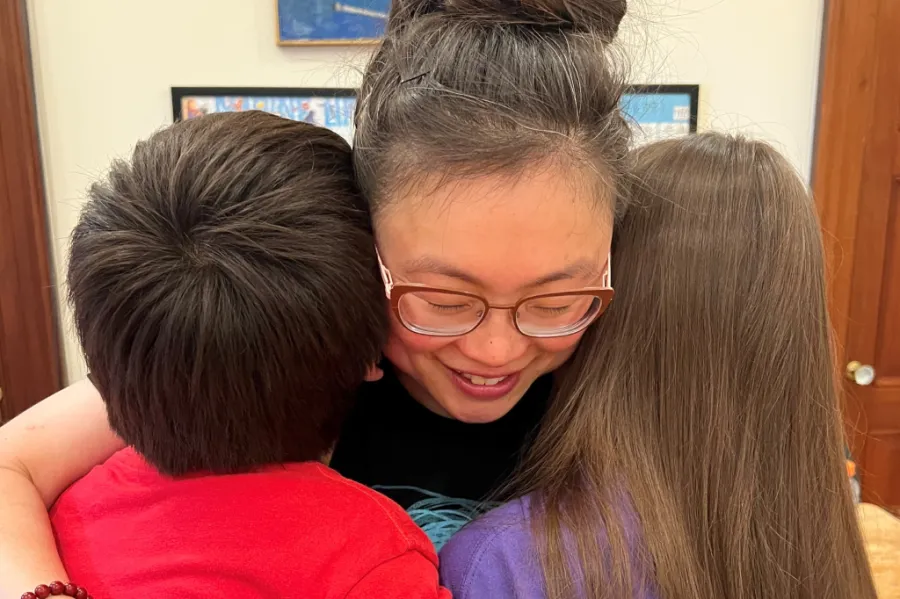
When you are the parent of a child with complex medical and developmental needs, you become many things at once: caregiver, advocate, researcher, coordinator and often, interpreter of a world that doesn't always understand your child. For one mother, her journey caring for her son taught her that the most important breakthroughs didn't just come from treatments or therapies, but from understanding, both her child and herself, in an entirely new way.
Jordyne’s son, now 11, experienced a stroke before he was born, which led to a number of visible and invisible challenges as he grew. The visible effects included motor differences that required years of physical and occupational therapy.
But Jordyne says the invisible effects were often the most misunderstood: auditory processing difficulties, subtle visual processing challenges, attention regulation issues and language processing delays. In busy classrooms or loud environments, her son could miss information without realizing it. When overwhelmed, it sometimes looked like behavior problems to others, but to his family, it was clear that these moments were often the result of overload, not defiance.
Early challenges: When invisible differences are misunderstood
For years, his mother tried to help by doing what many parents do: stepping in quickly, correcting, reminding and trying to prevent mistakes before they happened. It came from love and fear. Fear that if she didn't intervene, things would get worse. Fear that every moment mattered too much to get wrong.
Then the family began working with a developmental pediatrician through Tufts Medicine, and their perspective began to shift. Jordyne first met Ludwig “Erik” von Hahn, MDCM, Division Chief, Developmental-Behavioral Pediatrics at Tufts Medical Center and Associate Professor, Pediatrics, Tufts University School of Medicine at a difficult time for her family. Her son was struggling with peer relationships, and Jordyne felt that teachers had difficulty understanding his needs or meeting him where he was developmentally.
The family felt they were at a crossroads and needed guidance on how best to support and advocate for him. They found that support in Dr. von Hahn.
Understanding behavior through a developmental perspective
Dr. von Hahn says that one of the biggest challenges for children like Jordyne’s son isn't their intelligence or potential, but whether the people around them understand how they experience the world.
"Every day, he works to scan his right visual field, manage his arousal, move his body from one place to another and communicate clearly—all at the same time, all day long,” he said. “When he does not respond in a positive way each time an adult tries to provide support that is not disrespect. It is exhaustion. We help the adults in his life see the difference."
"The biggest change at first wasn't my child," explained Jordyne. "It was our understanding of him and how we responded in the moment."
A shift in perspective: Co-regulation, repair and giving space
One of the most important lessons she learned was the importance of co-regulation: the idea that some children, especially those with certain neurological differences, rely on the calm nervous systems of the adults around them to help regulate their own. If the adults escalate, the child escalates. If the adults stay calm, the child has a chance to calm too.
"That was huge for me," she said. "I realized that the only way out of a hard moment was if I was calm, kind and compassionate because he reflects back whatever he's given. I learned that because of Dr. von Hahn."
Another lesson that changed their family's daily life was surprisingly simple: focus less on preventing mistakes and more on how quickly you recover from them.
Because of the way her son's brain is wired, impulsivity is something he will likely always work on. Instead of trying to eliminate impulsive moments entirely, they were taught to measure success differently, by how quickly he could recognize a mistake, repair it and move forward.
"That changed everything," she said. "Instead of 'How do we stop this from ever happening?' it became 'How fast can we repair and move on?' That's something he can actually succeed at. And when he succeeds, he builds confidence."
Through many conversations with Dr. von Hahn, she also realized the importance of giving children space, something that felt very counterintuitive at first.
"One of the biggest things I learned was that doing nothing is sometimes doing something," she explained. "If you step in too fast, they don't get the chance to learn from the experience. But if you give them space, you're showing confidence in them. You're saying, 'I believe you can figure this out.'"
Dr. von Hahn offers what Jordyne describes as “nuggets of wisdom”—brief, practical phrases of guidance or recommendations for handling specific situations and helping her son thrive, some of which she keeps written on scraps of paper as reminders.
A home shaped by curiosity, not correction
One phrase she now uses often with both of her children is: "I want to see how you're going to figure this out. I'll come back later and see what you did."
"It's such a small sentence," she said, "but it gives them ownership, confidence, and space to learn."
Another guideline that helped reduce stress for the entire family was the idea of the 75% rule. If a child is successful at something about 75% of the time or more, that's considered going well, not something that needs constant correction or intervention.
"I realized I was expecting perfection," she said. "But if you think about it, no human (adult or child) does anything perfectly. That one idea changed how I look at everything, not just for my son, but for my daughter too."
Over time, these lessons didn't just help her son. They changed the entire family dynamic.
"It made our home more playful, more curious and less pressured," she said. "Instead of assuming something will go badly, we say things like, 'I'm excited to see how you handle this,' or 'I wonder how today will go.' That curiosity takes away so much pressure."
Jordyne described how meaningful it was to work with a doctor who spoke directly to her child with respect, involved him in conversations about his own behavior and helped him understand himself, not just correct him.
A philosophy of compassion and partnership in care
That philosophy extends beyond Jordyne’s family to every child Dr. von Hahn sees.
"There are children in every school and every community — children whose potential stays locked away not because of their disability, but because the systems meant to support them were built without them in mind,” he said. “Compassion, respect, and partnership can change that. It is what we do every day in the Division of Developmental Behavioral Pediatrics at Tufts Medicine Pediatrics.”
Jordyne and her family felt that difference when visiting Tufts Medicine.
"He feels like his doctor is on his side," said Jordyne. "Not a pushover, not someone who lets everything go, but someone who respects him and believes he's capable. That makes a huge difference."
A lasting shift in perspective and family life
Looking back, she says the care they received didn't just help with school or behavior. It changed the trajectory of their child's life and their family's life.
"It was enlightening and transformative," she said. "We understand our child now. We understand how to help him, how to step back, how to step in, and how to keep things lighter. It didn't just change how we parent him. It changed how we think about raising children and how we relate to each other as a family."
Jordyne’s biggest takeaway for other parents is simple but powerful:
"Make it lighter,” she said. “Be curious. Focus on connection and recovery, not perfection. And remember that sometimes the most important thing you can do as a parent is stay calm, believe in your child, and give them space to grow."
For this family, that understanding and the support from Tufts Medicine made all the difference, not just in their child's progress, but in their confidence, their resilience and their hope for the future.
Ready to find answers for your child? Schedule a developmental pediatrics consultation with Tufts Medicine and get personalized support for your child and family’s unique needs.
