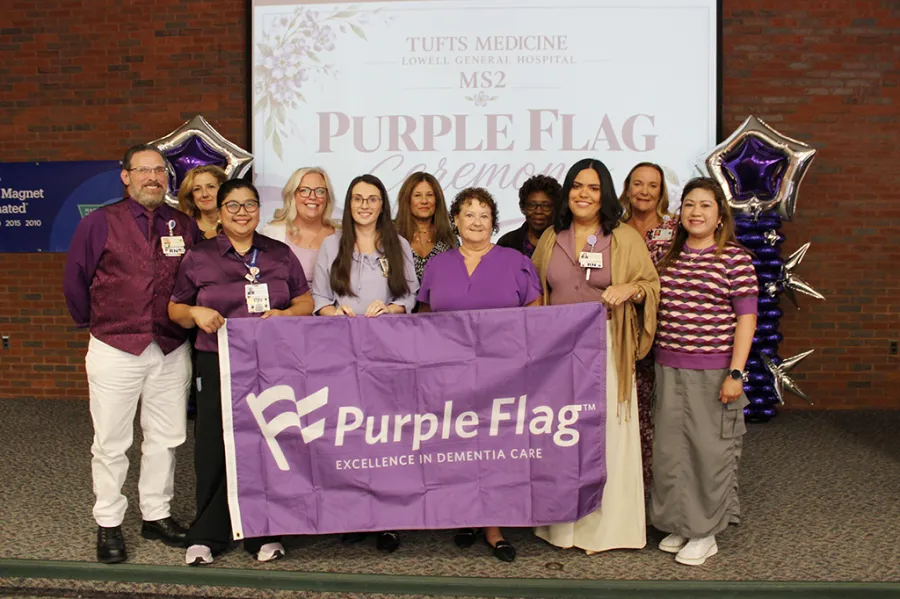
Tufts Medicine Lowell General Hospital has become the first acute care hospital in the nation to earn Purple Flag Excellence in Dementia Care™ accreditation, marking a significant expansion of how systematic, person-centered dementia care can be integrated into a hospital setting.
In an acute care hospital, individuals living with dementia are often admitted not because of their cognitive impairment, but because they are experiencing an unrelated medical problem such as a fall, infection, pneumonia or other acute illness. Their stays may last only days, requiring hospital teams to diagnose and treat the immediate medical concern while also addressing the unique risks an unfamiliar hospital environment can present for someone living with dementia.
"Dementia does not stop being part of a person's care needs when they enter a hospital for another medical condition," said Christopher Carter, Founder and CEO of Purple Flag Excellence in Dementia Care™ and President of the Connecticut Assisted Living Association. "Lowell General is demonstrating that person-centered dementia care can be incorporated into the fast-paced, medically complex acute-care environment. That represents an important evolution for Purple Flag and, more importantly, another way of improving the experience of people living with dementia and the families who support them."
Hospitalization can be particularly challenging for individuals experiencing cognitive impairment. Changes in surroundings and routines, unfamiliar caregivers and the stress of acute illness can contribute to confusion, anxiety, delirium and functional decline. In an acute care setting, dementia-sensitive practices must therefore complement medical treatment from the patient's arrival through discharge and transition to the next stage of care.
Lowell General's dementia-friendly MS2 medical-surgical unit provides a foundation for that approach. The model incorporates specialized staff education, individualized "About Me" information, familiar items from home, enhanced safety practices, purposeful activities and opportunities for patients to remain socially and physically engaged throughout their hospitalization.
Rather than creating a traditional long-term memory care environment within the hospital, the approach integrates dementia-sensitive practices into acute medical treatment, recognizing that cognitive needs remain important even when dementia is not the reason a patient was admitted.
"Earning Purple Flag accreditation as the first acute care hospital in the country is a testament to the extraordinary dedication of our care team and clinical leaders, who go above and beyond every day to provide high-quality, safe and dignified care to our patients living with dementia," said Amy Hoey, RN, President of Lowell General Hospital. "This recognition reflects their commitment to seeing each person beyond their medical condition—preserving dignity, engagement and connection even in the midst of a complex hospital environment. We are proud of what they've achieved, and even more proud of the difference it makes for the patients and families we serve."
Purple Flag accreditation evaluates providers according to 10 Best Practice Program Standards focused on establishing systematic, person-centered approaches to dementia care. The standards address areas including staff competency, safety, meaningful engagement, supportive environments, family involvement, quality of life and continuous improvement.
At Lowell General, applying those standards within an acute care model has the potential to extend dementia-sensitive practices across a patient's hospital journey, from emergency and inpatient care to diagnostics, rehabilitation, case management, discharge planning and transitions to home, skilled nursing or rehabilitation.
The milestone also broadens the potential reach of dementia-care quality initiatives beyond settings traditionally associated with memory care. As more than seven million Americans age 65 and older live with Alzheimer's disease or related dementias, individuals experiencing cognitive impairment increasingly interact with healthcare providers across many different settings and for medical needs that may have little to do with their dementia diagnosis.
"What began as a personal passion became our team's shared purpose," said Myra Dionido-Magat, BSN, RN, MS2 Clinical Manager. "Purple Flag is more than an accreditation—it is our promise to see the person beyond the diagnosis, provide dignity and compassionate care, and prove that excellent dementia care can thrive in an acute care setting. Together, we are transforming acute care."
Lowell General's accreditation demonstrates how dementia care principles can follow the person rather than remain confined to a particular type of care setting—supporting patients during acute illness while helping clinical teams preserve safety, dignity, engagement and independence wherever possible.