Larger challenges arise when a patient returns home with a host of instructions and medications they must follow. Poor compliance with those instructions can land the patient back in the hospital, a hardship for the patient that is also a driver of high healthcare costs.
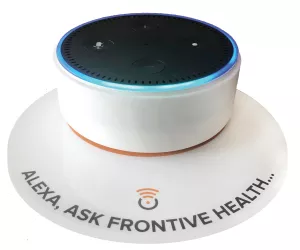
In the future, keeping up with those instructions may be as simple as talking to Alexa, Amazon’s interactive voice assistant.
Frontive, a California-based digital health technology company, has conducted its first-ever pilot for this new technology with knee replacement patients at Lowell General Hospital. Barbara Viens, DNP, RN, NEA-BC, ONC, Director of Orthopedic Services at Lowell General, says the pilot showed great promise.
“This technology could be a game changer,” Viens says. “We can help patients when they’re here in the hospital, but once they go home, this technology gives us the opportunity to continue that connection. The response we got from patients on their experience with the technology was extremely positive.”
Frontive hopes to fill an important gap in care left when patients go home to recover. In the pilot study, 40 patients scheduled to undergo joint replacement surgery were sent home with the Alexa tool two weeks ahead of time.
Jean Grieco, 78, was one of the participants.
“I am amazed at what Frontive Health can do and how it helped me after my knee surgery last year,” she said. “Even though I read through the binder of information I got at my pre-op session, I didn’t need to go back to it after my surgery because I could just ask Frontive. I asked personal questions about my health – from what medications I should take and when, to where I should be in my recovery – and it told me everything I needed to know.”
Knee replacement patients were selected for the initial pilot because they are sent home with a relatively standard but detailed set of instructions for their recovery. Non-compliance with those instructions can lead to complications and a return trip to the hospital. The tool gives patients reminders about medications and appointments and can answer questions about other discharge instructions.
“When patients are heading home after surgery or were just prescribed their 10th daily medication, expecting them to fully grasp and recall the details around all of these instructions is unrealistic and sets them up for failure,” says Anthony Jones, co-founder and CEO of Frontive. “Today, too much patient information is organized and presented to reduce liability instead of supporting patients the way they actually experience recovery and health management. We’re aiming to change this so that patients always feel supported and in control."
Viens, who recently completed her doctoral thesis on readmission reduction and seamless transitions to home, believes the technology holds enormous potential for patients managing chronic diseases like COPD or congestive heart failure.
“Patients with chronic illness are among the most challenging to treat and comprise a large portion of hospital readmissions,” she says. “This kind of technology can empower these patients to take control of their health at home. If they get the answers they need, they will remain healthier and that trend will bring down healthcare costs for all of us.”