What is Gamma Knife?
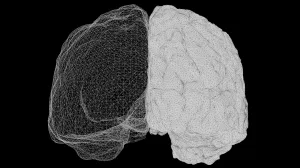
Gamma Knife is a form of radiosurgery that uses many tiny beams of radiation to treat a specific area in the brain. Despite its name, Gamma Knife does not involve an incision or a traditional surgical knife. According to Marie Roguski, MD, MPH, a Neurosurgical Oncologist at Tufts Medical Center and Associate Professor at Tufts University School of Medicine, Gamma Knife is a versatile technology used to treat patients with a variety of diagnoses including brain tumors – benign and cancerous – facial pain from trigeminal neuralgia, vascular conditions and others, and is considered the gold standard for intracranial stereotactic neurosurgery.
How should I prepare for my procedure?
Once your appointment with Gamma Knife is scheduled, one of our nurses will reach out and go through the procedure, step-by-step, ensuring that you have a full understanding of the procedure. You will receive another follow up phone call or email closer to your procedure date to see if you have any other questions. Depending on the type of procedure you are having, you may have an MRI just prior to your treatment. The team uses this MRI to identify the area being treated and develop a treatment plan specifically for you.
Your care team will give you specific instructions before your procedure. Be sure to complete and bring any paperwork you received for your MRI.
Let your care team know ahead of time if you:
- Are claustrophobic
- Have difficulty lying flat for an extended period
- Have metal in your body that may prevent you from having an MRI
Sharing this information in advance helps your team prepare for your needs and make your experience as comfortable as possible.
What happens when I arrive?
You and your family member or caregiver will have a private room where you can wait and get comfortable.
You’ll change into a hospital gown and remove metal jewelry, hearing aids and any dentures containing metal. A nurse will review your medications and allergies, go through a safety checklist and collect any necessary paperwork.
Your vital signs will be checked, and an IV will be placed. You may also be offered medication to help you relax.
What happens before treatment?
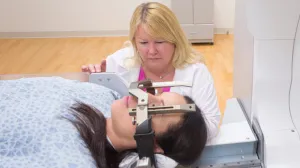
For many procedures your neurosurgeon will place a lightweight frame around your head. The frame helps keep your head still and allows the treatment team to correctly target the area being treated. Not all procedures require use of the frame.
The frame is secured with four small pins. Your doctor will use a numbing medicine on the areas where the pins will be placed. Frame placement usually takes about 10 to 15 minutes.
You may feel some tightness or pressure around your head when the frame is first placed. This usually eases within a few minutes and goes away within about 10 to 15 minutes.
After the frame is placed, a radiation physicist may take measurements of your head and/or frame. This does not hurt.
Will I need an MRI?
It depends. Some procedures require an MRI just prior to your Gamma Knife treatment. If yours does, you will go to MRI after the frame is placed on your head.
The MRI provides up-to-date images of the area being treated. Your treatment team uses those images to determine the exact location to treat and develop a plan specifically for you.
After the MRI, you’ll return to your private room while your team reviews the images and prepares your treatment plan.
How long will I have to wait?
There may be some waiting between your MRI and the start of your treatment. This can range from about 30 minutes to several hours, depending on your individual treatment plan and other factors.
Your care team will be available to answer questions and help you stay comfortable. You can use your personal electronics while you wait.
What happens during Gamma Knife treatment?
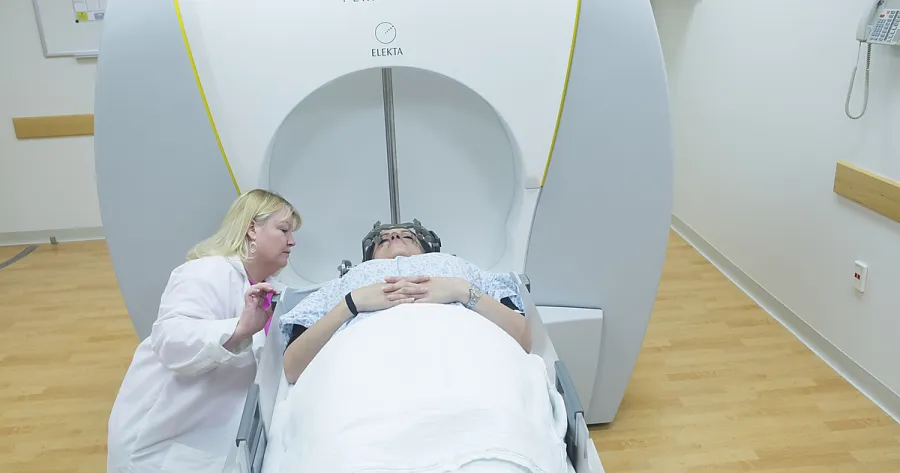
When it’s time for your treatment, you’ll lie on your back with the head frame connected to the Gamma Knife machine. The table will move into the machine, generally up to about your chest. You may feel slight movements during you treatment, this is normal.
The procedure is painless. You will not see, hear or feel the radiation during the treatment.
Your care team will remain nearby throughout the procedure. Cameras allow the team to monitor you, and a microphone allows you to communicate with them.
Treatment times vary from patient to patient and can range from about 15 minutes to several hours.
What happens after treatment?
When your treatment is complete, the table will move out of the machine. If you are wearing one, your care team will remove the head frame, which generally takes about two minutes and causes very little discomfort.
A dressing will be placed over the four pin sites.
Before you leave, your care team will review your discharge instructions, answer your questions and let you know when you can remove the dressing. This is usually about four hours after the procedure.
Most patients are ready to go home within about 30 minutes after treatment.
When can I return to my normal activities?
Most patients can resume their normal activities within a few days. Your care team will give you specific instructions based on your treatment and individual needs.
Be sure to follow the instructions provided at discharge and contact your care team if you have questions or concerns after your procedure.
Is Gamma Knife painful?
The Gamma Knife treatment itself is painless. You may experience some pressure or tightness when the head frame is first placed, but this generally eases within a few minutes.
The areas where the frame pins are placed are numbed, and removing the frame typically causes very little discomfort.
What’s the most important thing to know before you go?
Knowing what to expect can help make your Gamma Knife experience feel less overwhelming. Your care team will guide you through each step—from preparing for your MRI and placing the head frame to treatment and going home.
Gamma Knife is a highly accurate treatment that does not require traditional surgery, and most patients can return home shortly after their treatment.
If you have questions or concerns before your procedure, talk with your doctor or Gamma Knife care team. They’re there to help you feel prepared and comfortable every step of the way.
Questions about your Gamma Knife procedure?
Talk with your doctor or Gamma Knife care team for guidance specific to your treatment.