In 2024, Jack Halas Jr.'s life changed in a single night.
At just 43 years old, the former athlete and coach suffered three simultaneous ischemic strokes. Within hours, the man who had spent his life on baseball fields and basketball courts as a player and coach suddenly found himself lying in a hospital bed, unable to move normally and wondering if he would ever walk, speak or coach again.
Finding the right recovery team
Recovery from a stroke isn't simply about regaining strength. The brain must relearn how to move, communicate and perform everyday activities. That requires therapists with specialized training in neurological rehabilitation.
Jack’s stroke recovery took him through numerous hospitals and organizations before finding the right team to help him meet his recovery goals. He found that expertise with the neuro rehabilitation program at MelroseWakefield Hospital.
Delivered across two outpatient locations in Medford and Wakefield, the program brings specialized neurological rehabilitation close to the communities it serves. Patients like Jack don’t have to travel to a major academic medical center to access expert care. That accessibility matters—because recovery from neurological injury is not a single appointment. It is a sustained, evolving process that demands consistent, high-level clinical support over time.
The program treats a broad spectrum of neurological conditions including stroke, traumatic brain injury, Parkinson’s disease and Parkinsonism, multiple sclerosis and other acquired neurological disorders. Within those diagnoses, the clinical team addresses the full range of functional challenges patients face: impaired mobility, balance deficits, reduced upper extremity function, communication and swallowing disorders, cognitive changes and the loss of the everyday routines that give life its meaning.
A true multidisciplinary team
What separates neuro rehabilitation from general outpatient therapy is the depth of its specialization and the intentional coordination among disciplines. Recovery from neurological injury is never one-dimensional—and Tufts Medicine’s approach reflects that reality, using physical therapy, occupational therapy and speech-language pathology.
At the Medford clinic, physical and occupational therapists collaborate side-by-side so that mobility and functional gains reinforce each other. Speech therapy services in Wakefield extend that coordinated model to communication, cognition and swallowing. The result is a unified plan of care—not a series of parallel, siloed appointments—centered entirely on the patient.
The therapists have gone through a specific neurology rehabilitation certification process and are specially trained to treat patients recovering from neurological conditions using evidence-based rehabilitation techniques designed to harness the brain's ability to reorganize and create new pathways through neuroplasticity.
One goal at a time
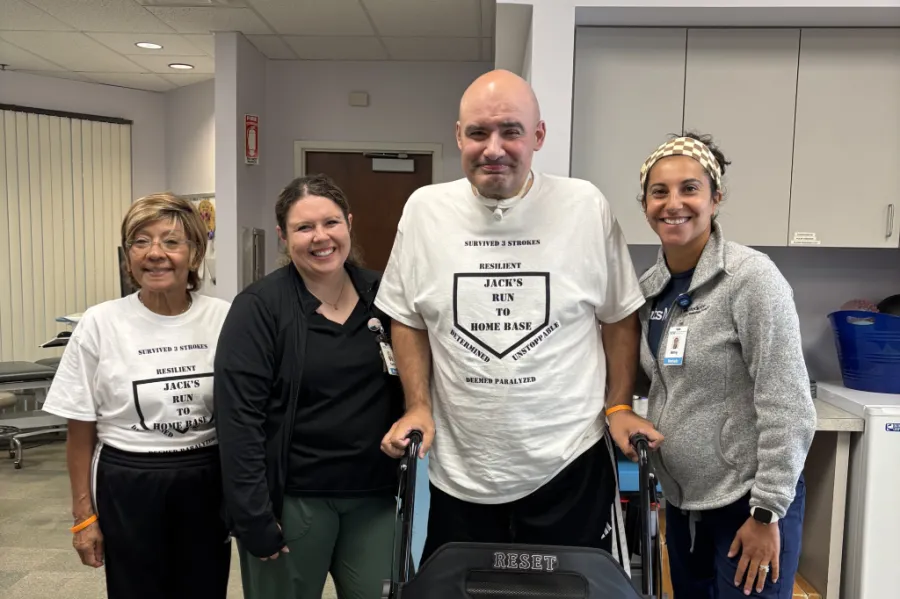
According to Kayla Comerford, PT, who has been Jack’s physical therapist throughout his recovery, every exercise has a purpose: building strength, improving balance, developing endurance and restoring the physical confidence that neurological injury erodes so quietly.
As Kayla has explained, neuro rehabilitation isn’t just about fixing a problem in the moment—it’s about giving patients the tools they need to live their lives as fully as possible. Her perspective on that mission is clear: “When people receive a diagnosis like stroke or Parkinson’s disease, they’re often told what they may lose. Our job is to show them what they can still gain—strength, confidence, independence and hope.”
Perhaps the hardest part of stroke recovery is accepting that your body may not work exactly the way it once did. Jack’s left side has been a particular challenge. But occupational therapist Amy Bloom has helped him understand something important.
“Recovery isn’t always about getting back to exactly where you were. Sometimes it’s about making small adjustments that allow you to continue doing the things you love.”
Amy Bloom
Occupational Therapist
That reframe—from deficit to adaptation, from loss to possibility—is itself a clinical achievement.
Communication is fundamental to identity, to relationships and to participation in ordinary life—and the possibility of losing it is among the most frightening aspects of neurological injury.
Megan Kent is a Speech-Language Pathologist at Tufts Medicine’s Wakefield outpatient rehabilitation program. Her work with Jack has helped him communicate more clearly and confidently by using a speaking valve attached to his tracheostomy, addressing not just the mechanics of speech but the sense of self that language carries with it. For a man who spent years coaching young athletes—leading teams, inspiring effort, holding locker rooms together with his voice—being able to speak with strength and clarity again was not a clinical outcome. It was a homecoming.
The power of coordination
One of the things that makes Tufts Medicine’s neuro rehabilitation program exceptional is the way its therapists function as a unified team. Kayla, Amy and Megan don’t simply run separate sessions in parallel. They coordinate. They communicate. They align their goals so that every aspect of Jack’s recovery—physical, functional and communicative—moves in the same direction at the same time.
A new finish line
Instead of wondering whether he would ever walk again, Jack prepared for and completed the Red Sox Foundation's Run to Home Base at Fenway Park. In an emotional finish, he was greeted at the finish line by family, including his sister Jennifer Jodoin, brother-in-law Rick Jodoin and niece Eva D’Amico, who have been his “beacons of hope” throughout his recovery journey.
“The event itself was amazing! My mother Amelia did the majority of the pushing me in my wheelchair; however, I walked into the stadium to complete the challenge,” Jack said. “My experience with the Tufts Medicine rehabilitation team has been outstanding and they have been tremendous in improving my situation. They have worked tirelessly for me.”
His journey is a reminder that with expert neurological rehabilitation, an experienced care team and unwavering perseverance, recovery can lead to milestones that once seemed impossible.
Ready to take the next step in recovery? Learn more about Tufts Medicine’s specialized rehabilitation services and how neuro rehabilitation can help patients regain function, confidence and independence after a neurological injury.