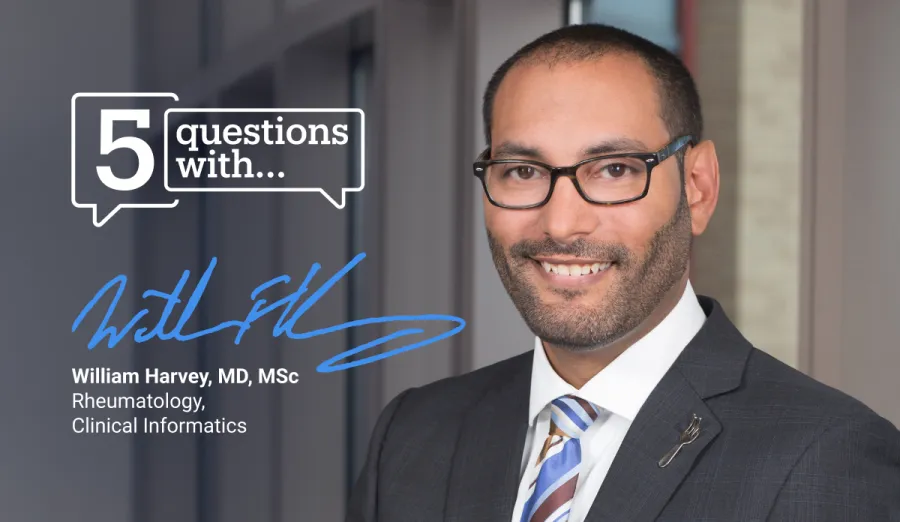
Dr. Will Harvey wears many hats. He leads our clinical informatics initiatives, including the management and optimization of EPIC, our electronic medical record system. He also continues to see patients as a practicing rheumatologist. In October Dr. Harvey began his term as President of the American College of Rheumatology (ACR), a national role that reflects his deep dedication to patient care and physician advocacy. We spoke with Dr. Harvey about what motivates him, what leadership means to him and how his work at Tufts Medicine continues to shape the future of care.
1. Why did you become a rheumatologist?
I was drawn to musculoskeletal medicine early on. I was an athlete in high school and always had an interest in how the body moves. For a while, I considered orthopedic surgery, but rheumatology struck the right balance for me. It allowed me to work on complex musculoskeletal issues while also building long-term relationships with patients over many years.
There’s also something very intellectually rewarding about rheumatology. It's often seen as a specialty of medical mysteries. We're the ones who get called in when no one else can figure out what's going on. That deep problem-solving aspect really appealed to me, and in many ways, it mirrors the work I do in informatics today.
2. What inspires you about your work at Tufts Medicine?
It’s the people and the patients—always. I see such resilience in our clinicians. Even when they're struggling with systems or workflows that aren't serving them well, they persevere because they care deeply about providing great care.
That’s what motivates me, particularly on the informatics side. If I can make it easier for a doctor or nurse to do their job—give them 15 minutes back in their day—I know that time will be spent thinking more deeply about a patient, making a phone call to a colleague or taking that extra moment to connect. Helping clinicians care better for patients is what gets me up in the morning.
Whether it was my team in Rheumatology supporting me in adopting new technologies, or the entire organization encouraging me to pursue national leadership with the ACR, I’ve always felt that Tufts Medicine is a place where people lift each other up. Everyone is working together toward the same goal: better care for our patients.
3. What’s a lesson you’ve learned that shapes how you lead?
That leadership isn’t about you. It’s about the people you’re privileged to lead. Your job is to make them successful.
Tufts Medicine has a long tradition of quiet excellence and servant leadership, and I see it in action every day. Whether it’s in a clinical department or a technology project, our leaders are constantly asking: “How can I support the people doing the work?” That mindset has stayed with me and guides how I try to show up every day.
4. What initiatives or programs do you believe embody Tufts Medicine’s mission and values?
One of the most exciting initiatives right now is the integration of Ambient Listening Technology into our clinical workflows. Specifically, we’ve adopted Microsoft DAX, which listens to doctor-patient conversations and automatically drafts clinical notes in real time. It’s a great example of how we’re using technology not just for the sake of it, but to reduce administrative burden and give clinicians more time for meaningful patient care.
This is a perfect example of our mission in action—providing excellent, patient-centered care by empowering our teams with the right tools. It's innovation that directly supports our values.
5. In October you began your term as President of the ACR. What's your vision for your new role?
It’s a tremendous honor, and I see it as a responsibility and an opportunity. As President of the American College of Rheumatology, I’ll help lead initiatives that range from publishing cutting-edge research to developing education programs and advocating for better patient access to medications and care.
What’s exciting is how much this national role intersects with what we do here at Tufts Medicine. I’ve brought back ideas from the national stage—like incorporating physician assistants into multidisciplinary care teams—and seen them thrive locally. And the leadership skills I’ve developed here at Tufts Medicine have absolutely prepared me for this next chapter.
Ultimately, it’s about advancing the field of rheumatology while staying grounded in what matters most: patients, care teams and improving lives.
Learn more about cutting-edge rheumatology care at Tufts Medicine