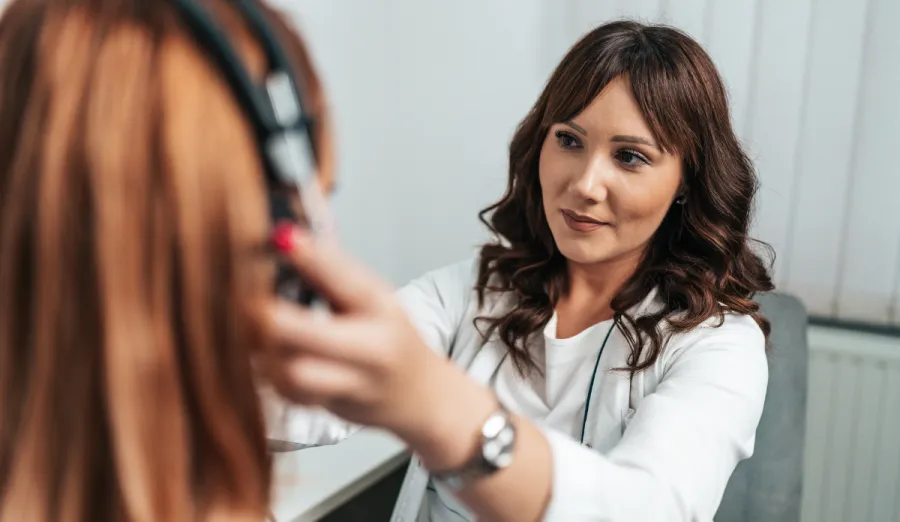
When Erin O’Sullivan woke up one morning, she immediately noticed something was off. She couldn’t hear out of her left ear. For most people, that would be alarming enough. But as a nurse practitioner, Erin understood that this wasn’t something to ignore.
“I woke up and just knew something was wrong,” she recalls.
According to Matthew Russell, MD, Chief of Otolaryngology at MelroseWakefield Hospital, Erin experienced sudden sensorineural hearing loss (SSNHL), a rare condition where a person rapidly loses hearing in one ear, often within hours or days. SSNHL affects roughly 5 to 20 people per 100,000 annually, and it’s most often one-sided. Immediate medical evaluation is critical—ideally within a few days.
“Sudden sensorineural hearing loss is considered a medical emergency,” said Dr. Russell. “If untreated, the damage could become permanent.”
SSNHL typically has no known cause, although it can occasionally be linked to viral infections, vascular issues, head trauma, or autoimmune disease. It may be accompanied by tinnitus (ringing in the ear) or vertigo (a spinning sensation).
Acting quickly: A life-changing decision
Dr. Russell immediately started Erin on high-dose oral steroids, the standard first-line treatment for SSNHL. But O’Sullivan, driven by her medical background and sense of urgency, did her own research and self-advocated for an additional option: hyperbaric oxygen therapy (HBOT).
“HBOT is not the standard treatment for SSNHL, but studies suggest that it can improve outcomes when combined with steroids,” said Dr. Russell. While not a replacement for steroids, hyperbaric oxygen therapy can help some patients, particularly in more severe cases. It involves breathing 100% oxygen in a pressurized chamber, which may improve oxygen flow to the damaged inner ear. Treating SSNHL with HBOT is not covered by most insurance plans, so be sure to check with your insurance provider before starting treatment.
With approval from Dr. Russell, Erin began a series of ten two-hour sessions in the hyperbaric chamber located at the MelroseWakefield Hospital Wound Center.
At the time of diagnosis, Erin had lost 80% of her hearing in her left ear. The hearing loss impacted her daily life in ways she didn’t expect. “I avoided going out because everything sounded distorted, like I was underwater or in a fishbowl. Even walking my dog was a concern because I couldn’t hear approaching cars.”
“Each treatment felt like flying—your ears pop from the pressure, just like when a plane ascends or descends,” she says. “But by the end of the course, my hearing had improved significantly.”
Today, Erin feels incredibly grateful—not just for the improvement in her hearing, but for the quick access to care and her ability to advocate for herself.
“You take hearing for granted,” she said. “Even the simple things, like being able to have a conversation in a noisy restaurant again, means the world.”
If you ever experience sudden hearing loss:
- Seek medical attention immediately: Primary care, urgent care or the emergency department can help rule out more common causes like earwax, ear fluid or infections.
- Get a formal hearing test: An audiogram is essential and should be followed by a consultation with an ENT specialist.
- Start treatment early: High-dose steroids—either oral or injected into the middle ear—should begin as soon as possible and within a month of onset for best results.
- You may need an MRI: This helps rule out rare causes such as a vestibular schwannoma, a benign tumor of the hearing and balance nerve.
- To rule out a simple blockage, try humming: If the sound is louder in your “bad” ear, the cause might be earwax or fluid—not nerve damage.
Though there’s no known way to prevent SSNHL, protecting your hearing in everyday life is essential:
- Use hearing protection in loud environments.
- Avoid inserting anything into your ears.
- Wear helmets during high-risk activities like biking or skiing.
- Manage chronic conditions like diabetes or autoimmune disease.
Erin’s story is not just one of medical recovery—it’s also a reminder of the importance of listening to your body and speaking up for your health. “I think the hyperbaric treatments had a lot to do with my recovery,” she says. “But what made the biggest difference was seeking help early.”
Get help hearing, speaking, swallowing and breathing more comfortably