When Bob’s appendix burst at 17, he never imagined it would come back to haunt him 45 years later.
But that’s exactly what happened in March of this year. One night, Bob was kept awake by severe, unexplained stomach cramps and pain. Hoping it was nothing more than an upset stomach, he took Pepto Bismol—but the discomfort only worsened. By 7:30 am on March 30, he drove himself to the emergency department at Tufts Medical Center. There, a CT scan revealed the true cause: a small bowel obstruction. After more than three days of intense pain managed with round-the-clock narcotic medication, Bob was scheduled for surgery on April 2.
The small bowel obstruction was caused by scar tissue from two surgeries he had previously undergone to remove his appendix. The scar tissue formed adhesions that blocked his small intestine, preventing digested food and waste from passing through.
“I thought it was probably adhesions, but I didn’t even think of a blockage, to be honest with you,” he said. “I was a little bit surprised when the ER doctor said, ‘I think you have a blockage,’” and showed him the scan.
Generally, the first line of treatment for small bowel obstructions is to see if the issue resolves on its own, as surgery can cause more scar tissue that may lead to future obstructions.
“The three days before the surgery were awful,” Bob said. “It wasn’t very pleasant at all. You’re not eating, so they put you on constant IVs.”
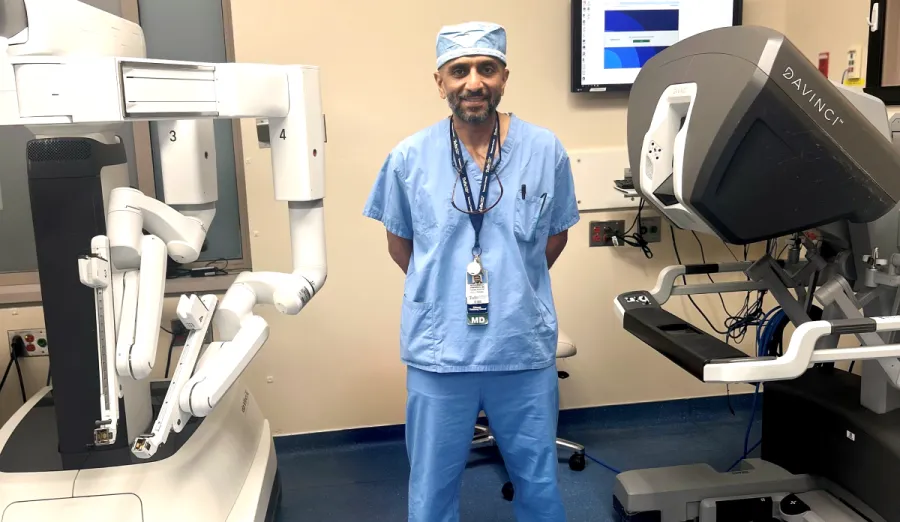
Initially, Bob was told they may not be able to perform his surgery laparoscopically, and he would have to have open surgery. The risk with open surgery is that more scar tissue could form. Instead, Tufts Medical Center trauma surgeon, Mohammed Bawazeer, MD decided that the best course of treatment was to perform robot-assisted emergency surgery.
Robot-assisted surgery, also known as robotic surgery, involves a surgeon manipulating multiple robot arms and instruments from a console. This minimally invasive surgery can be used for complex procedures and often requires only small incisions, increasing precision and resulting in a faster recovery time.
The field of robotic surgery is not new. It initially started with gynecologic and urology surgery, where they work primarily in the pelvis. The advantages of robotic surgery include precision, dexterity, 3D visualization and magnification. The patients experience less pain and an early return to regular activities. Its application has expanded to many other fields, including trauma and emergency surgery. Surgeries such as emergency gall bladder surgery for an inflamed gall bladder, obstructed and strangulated hernias, small and large bowel obstruction and bowel perforation are made a lot easier with the use of the robot. In trauma situations, the robot-assisted surgeries have advantages in operations like removal of the spleen, repair of diaphragmatic injuries and repair of small and large bowel injuries, depending on the stability of the patient.
“In cases like Bob’s, where prior surgeries have created a lot of scar tissue, robot-assisted surgery gives us a real advantage,” said Dr. Mohammed Bawazeer. “The technology allows for greater precision with smaller incisions, which helps minimize the formation of new scar tissue—one of the biggest concerns in repeat abdominal surgeries. It also minimizes handling of the bowel, which resulted in faster return of bowel function. In cases like these, the robot helped to see the bowel moving forward immediately after the scar tissue had been released. The benefits of robot-assisted surgery are especially important in emergencies.”
Bob stayed in the hospital for four days after the surgery and was kept on IVs until his system could tolerate a liquid diet. Liquid was gradually reintroduced, and then he was put on a soft diet. Eventually, he was able to eat a full diet, but it takes a while for your digestive system to synchronize after the surgery, he said.
“Every week I felt a little bit better,” he said.
After the surgery, Bob said he no longer had to take pain medication like he did leading up to it. Today, he feels as though he’s 90–95 percent recovered.
“There are a lot of great providers there, whether they were nurses, doctors, or techs, and I was fortunate to have Dr. Bawazeer as my surgeon, who has a lot of experience with this type of surgery.”