One day, years from now, Alysha MacDougall, 33, from Brockton, MA, will tell her 6-month-old son the story of his birth. And it will be just as unbelievable then as it is now.
Alysha and her boyfriend Carl had talked about having children one day, but Alysha had serious doubts about her ability to become pregnant. She was taking a GLP-1 (and had lost 45 pounds) and was seeing an OB/GYN after a diagnosis of polyendocrine metabolic ovarian syndrome (PMOS), which can make it difficult to conceive.
On January 25, 2026, Alysha was on her way to a friend’s baby shower when she was rear-ended while stopped at a red light. She seemed fine, and there was no visible damage to her car, so Alysha continued on to the celebration and then later drove home through what was the start of a significant winter storm. She went to bed early that night, but awoke at 3am with excruciating abdominal pain. She made her way to the bathroom, where Carl found her, passed out on the floor in a puddle of blood.
Carl was able to revive Alysha, who told him she couldn’t feel her legs. Carl called 9-1-1. At that point, there was two feet of snow on the ground and the streets were barely plowed, but an ambulance and fire truck made it to their house to take Alysha to Brockton Hospital. Carl would need to go separately. While en route to the hospital, an EMT asked Alysha if she could be pregnant.
“I didn’t think there was any possible way,” Alysha recalled. “I wasn’t showing, I had PMOS and any symptoms I had were typical side effects of taking a GLP-1.”
Alysha was still in terrible pain and had lost a lot of blood. As she drifted in and out of consciousness, she mumbled to the EMT that she felt like she was passing a blood clot. The EMT looked down. “No,” she said. “You’re having a baby.”
Alysha’s whole world froze. “I remember thinking, ‘Why was there no crying? Was the baby breathing? Did I have a boy or a girl?’”
The baby was a boy, delivered in the back of the ambulance. And he was extremely premature—doctors would later estimate between 22 and 23 weeks gestation. He weighed 450 grams—less than 1 pound. The ambulance, which was not equipped to accommodate premature babies, sped on to the hospital, as an EMT put an adult oxygen mask over the baby’s face and began chest compressions. Alysha, who just moments before had been worrying that she was going to die, had immediately switched into full-on mom protective mode.
“I wanted to do everything possible to give him the best shot at life,” she said. “From the minute he arrived, it was baby first, mom second.”
As luck would have it, Neha Chaudhary, MD, Neonatologist at Tufts Medical Center and Assistant Professor, Pediatrics, Tufts University of Medicine, was about to start her shift at Brockton Hospital, where Tufts Medical Center Newborn Medicine experts help staff the neonatal unit. She arrived about two minutes before the ambulance, and within minutes of arrival, Dr. Chaudhary expertly intubated the tiny baby on the bottom of Alysha’s stretcher. This quick, decisive action almost certainly saved his life.
Meanwhile, Alysha had delivered the placenta in the Emergency Department—it had abrupted, almost certainly from the car accident the day prior, triggering the premature delivery. Her family arrived and she was reunited with Carl, who had learned he was a new father via a speakerphone call from a nurse while in the car on the way to the hospital. They named the baby, Julian. Alysha was able to have five minutes with him, before the Tufts Medical Center NICU transport team arrived and whisked Julian away to Boston for high-level care in Tufts Medical Center’s Level III NICU. Alysha joined him at the Medical Center hours later.
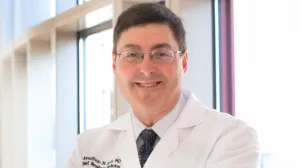
“Twenty-two weeks is the very edge of viability for premature babies,” said Jaclyn Boulais, MD, Medical Director of the Neonatal Intensive Care Unit (NICU) at Tufts Medical Center and Assistant Professor, Pediatrics, Tufts University School of Medicine. “He was fragile, unstable and needed meticulous care, including maximum ventilator support. His skin was paper-thin. For babies as premature and sick as Julian was, his overall chance of survival was at about 15 percent in the best case scenario, with an 80 percent chance of moderate-to-severe neurodevelopmental impairment. But while his parents acknowledged reality, they chose positivity.”
“The NICU care team was so kind, but also upfront and honest with us about Julian’s outlook,” said Alysha. “But we saw him moving and kicking his legs and we knew in our hearts that we wanted to do everything possible to save him.”
And that optimism was rewarded on the very first day with another miracle: ultrasound imaging showed no signs of any brain bleeds. Julian’s doctors were shocked.
“It’s incredibly uncommon for babies of this gestational age to have no brain bleeding,” said Dr. Boulais. “Many of these extremely preterm babies born outside a tertiary care hospital have substantial bleeding, but nearly all have at least some. It’s one of the biggest markers of long-term neurological impact.”
Subsequent ultrasounds continued to be negative. Julian’s grateful parents were overjoyed.
“There was no damage to his brain. It was completely normal—everyone was amazed,” said Alysha. “Maybe because he was born during a blizzard, his body shut down to preserve his brain. All the tests were negative for any red flags for long-term effects.”
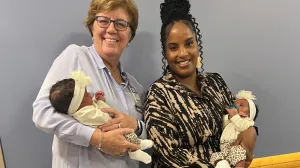
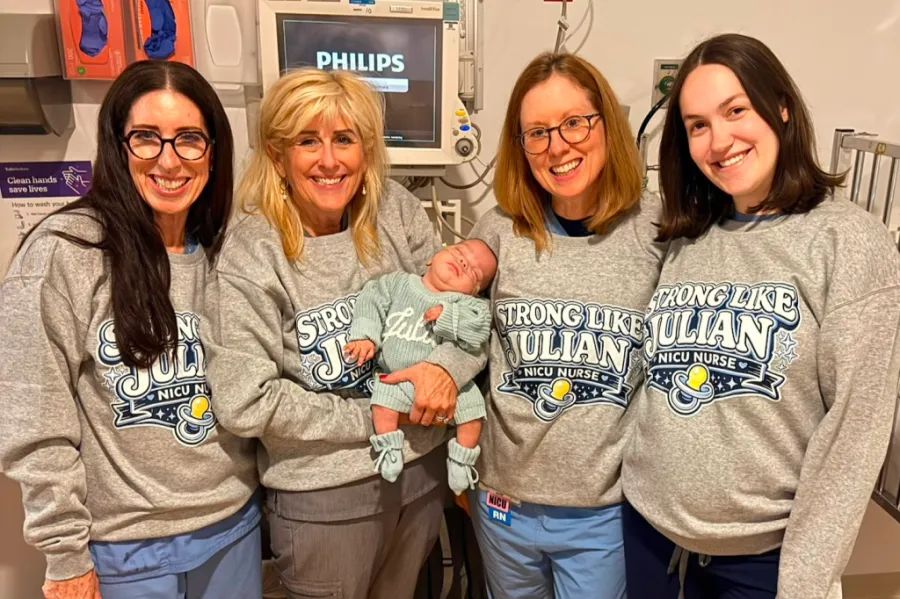
While the road was long, and there were bumps along the way, Julian continued to get healthier, bigger and stronger. He overcame adrenal insufficiency and setbacks in his respiratory support and blood pressure. He also required laser eye surgery for retinopathy of prematurity, an eye disease commonly found in extremely premature babies. But Alysha and Carl relished the loving care he received from the Tufts Medical Center NICU nurses and doctors and celebrated every milestone: After 55 days, the ventilator was removed and Julian was able to breathe on his own. After that, Alysha was able to hold her son for the first time.
“Now he wants to be held 24/7,” she laughed. “We really fell in love with the NICU staff. I went back and forth virtually every single day and there was just so much love and support for Julian and our whole family. We are truly grateful.”
On May 10, 2026—Alysha’s first Mother’s Day—Carl asked her to marry him. She said yes. The NICU nurses knew about the proposal well in advance and gave Carl advice on how to make the moment extra special. And on June 29, 2026—154 days after he first arrived in the NICU weighing less than a pound, Julian was discharged home, tipping the scales at a chunky 10 pounds.
“He went home with some oxygen support, and he will need follow-ups with ophthalmology, cardiology and pulmonology, as well as early intervention,” said Dr. Boulais. “But all of this is standard for Julian’s level of prematurity. He required incredibly intensive care throughout his stay in the NICU, but now he's doing beautifully. He is a survivor who has truly defied all odds.”
“We were so worried about all the things we didn’t do in preparation for having a baby, because we didn’t know we were having a baby,” said Alysha. “But we made it through, he’s home now and he’s perfect.”
When babies arrive too soon or need specialized care, the experts in Tufts Medicine Newborn Medicine are here 24/7. Learn how our nationally recognized team cares for the smallest and sickest newborns.