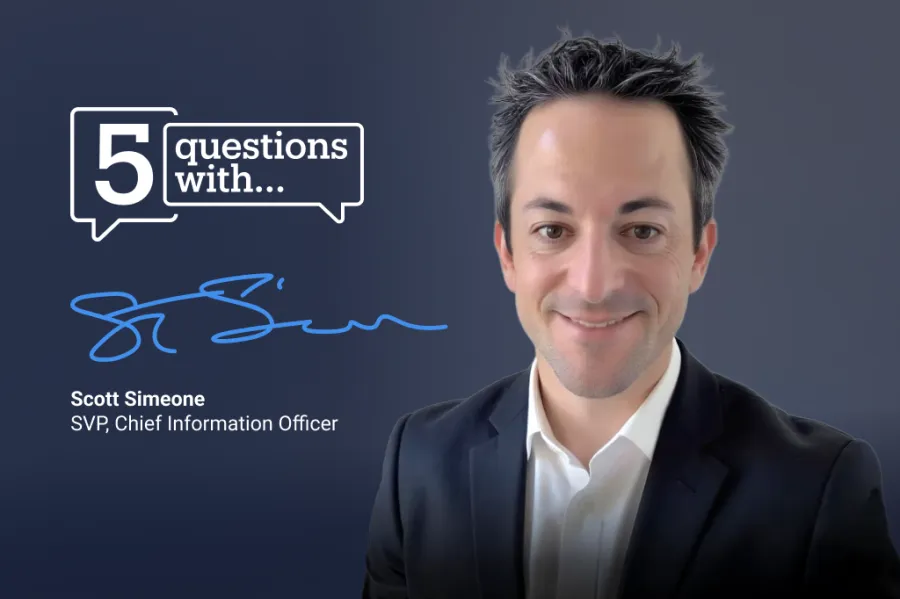
Scott Simeone discusses the promise of AI, reducing clinician burden and why successful innovation starts with people and not technology.
1. What originally drew you to healthcare, and what’s kept you passionate about it?
I've always wanted to work in healthcare. I was a paramedic in my early 20s and originally planned to go to medical school. What I loved about healthcare was the immediacy of it. You're constantly making sense of incomplete information, solving problems in real time and helping people when they need it most.
Along the way, I realized I was just as interested in the systems behind care as I was in the care itself. I found myself drawn to questions like: How do we make this process work better? How can technology remove barriers and help caregivers focus more on patients? It was a natural intersection of healthcare, technology and problem-solving. That combination has kept me engaged throughout my career.
2. What excites you most about where technology can take patient care and the care team experience over the next five years?
What excites me most is the possibility that technology, including AI, can finally start taking work out of the system instead of adding more to it.
I often think about my own mom navigating healthcare because it reminds me who we're really building these systems for. Most patients don't care whether a solution uses AI or the latest technology. They care whether it's easier to schedule an appointment, understand their care plan or get answers to their questions. The best technology removes friction rather than creating it. If we're doing it right, patients and caregivers spend less time dealing with systems and more time focused on care.
3. As CIO, how do you evaluate emerging technologies like generative AI and decide what's worth pursuing?
I try to evaluate every technology from the problem backward rather than from the solution forward.
The first question is always, "What are we trying to solve?" From there, we look at whether the technology fits naturally into the workflow, whether we can implement it without adding complexity and whether it helps build trust with patients and clinicians.
We also have to be able to measure it. Is it actually moving the needle in a meaningful way? Is it improving outcomes, reducing burden or creating a better experience? Technology is evolving incredibly quickly, but more change isn't always better. The people on the receiving end of that technology—our patients and care teams—have to remain at the center of every decision.
4. Where do you see the biggest opportunities for technology to reduce burden for clinicians?
There are two areas that stand out.
The first is documentation. What used to feel aspirational is becoming increasingly real. Technologies like ambient listening, computer vision and AI-assisted documentation have the potential to dramatically reduce the amount of time clinicians spend documenting care.
The second is tackling everyday friction. Things like inbox burden, repetitive administrative work and even the number of times people have to log in throughout the day may seem small, but they add up. If we can eliminate those pain points, we can give caregivers valuable time back and allow them to focus more on patients.
Looking further ahead, I think we'll also see technology unlock entirely new care capabilities. Today, clinicians spend valuable time collecting and documenting information that technology may eventually be able to capture automatically, creating opportunities for more proactive and personalized care.
5. What's one lesson you've learned about healthcare innovation that has shaped your leadership approach?
One of the most important lessons came from a project that didn't go the way I expected. We were evaluating a wearable technology that could continuously monitor patients' vital signs. The technology itself was impressive, and I was focused on the possibilities—reducing burden, generating more data and improving our ability to predict deterioration and other clinical events.
What I didn't fully appreciate at the time was the care model. We hadn't thought enough about how clinicians would use all that information or how it fit into their workflows.
That experience taught me that technology can't come first. Innovation has to start with the people providing care and the workflows that support them. The question isn't "How do we implement this technology?" It's "How can technology help us improve the way care is delivered?"
That's a lesson that still guides me today. The most successful technology implementations aren't about introducing new tools. They're about helping people work better, reducing unnecessary burden and ultimately improving the experience for patients and caregivers alike.
Help shape the future of healthcare
From clinicians and researchers to technology and operational leaders, Tufts Medicine is building a team dedicated to improving care through innovation, collaboration and compassion.