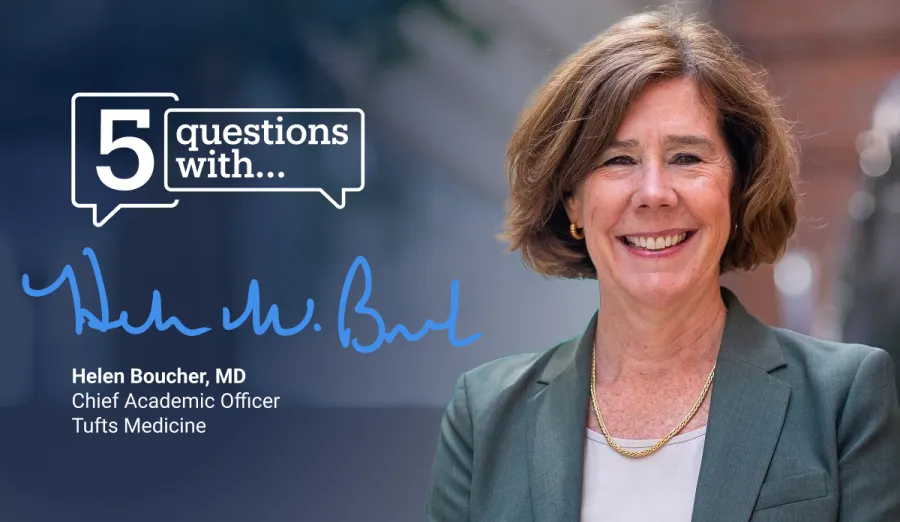
As Dean of Tufts University School of Medicine and Chief Academic Officer for our health system, Dr. Boucher is guiding the next generation of healthcare professionals while championing research that pushes medicine forward. A respected infectious diseases physician, Dr. Boucher has devoted much of her career to tackling antimicrobial resistance and improving care for patients everywhere. We sat down with Dr. Boucher to learn more about what inspires her, her perspective on leadership and why she believes Tufts Medicine is uniquely positioned to shape the future of healthcare.
What first drew you to medicine, and if you hadn’t become a doctor, what do you think you’d be doing today?
I actually fell in love with medicine in the fifth grade. I had some unusual health issues as a child, which meant I spent a lot of time with my pediatrician. I absolutely idolized him, and those early experiences opened my eyes to what caring for people could look like. From that point forward I never really let go of the idea of becoming a doctor. If I weren’t in medicine, I’d probably be a teacher. I taught middle school science for two years before medical school and loved it. There’s something powerful about helping someone discover what they’re capable of, watching curiosity turn into confidence. That experience never left me.
What keeps you inspired?
My role is unique because it spans patient care, research, and education every day, and that intersection is exactly what inspires me. I’m motivated by the opportunity to help shape the future by training physicians, scientists, public health professionals, and other members of the healthcare team, while also advancing discovery that improves lives.
What’s especially meaningful is watching that journey unfold over time and seeing how it ultimately changes lives. We work with students who join us as early as high school and continue through advanced training and degrees, contributing to research and care innovations that address the real challenges our patients and communities face. Seeing that progression—curiosity turning into purpose and learning turning into impact—these are not just academic pursuits; they are levers for societal change.
What are some of the initiatives or programs that you think best reflect Tufts Medicine’s values?
There are so many. Our expanding Research Enterprise aligns directly with our mission to improve patients' lives, advance health justice and transform health education.
The growth of education across our system is one of our strongest examples. Seeing our nursing colleagues at Lowell General Hospital and MelroseWakefield Hospital engaged and energized by teaching has been incredibly rewarding, and the quality of instruction has been outstanding.
I’m also excited about our work in primary care, which aligns with our focus on health justice and transforming health education. The Women’s Health and Menopause Initiative is another wonderful example of what becomes possible when the university and health system work closely together. It’s already creating momentum for new research and new models of care that women truly deserve.
You’ve dedicated much of your career to antimicrobial resistance. Why is this issue so important?
Antimicrobial resistance is a global problem that threatens our ability to deliver modern medical care. Early in my career I studied resistance at a basic science level, then moved into drug development while working in London. Over time I saw how resistance makes treatments like joint replacement or chemotherapy impossible for some patients because the infections we encounter no longer respond to available antibiotics.
We address this through infection prevention, stewardship and research. Tufts Medicine has long been a leader in antibiotic stewardship, which means using the right drug at the right dose for the right duration in every patient. We also support advanced laboratory science to track resistance across our hospitals and units. Our Center for Integrated Management of Antimicrobial Resistance (CIMAR) brings together experts across Tufts to improve education, research and innovation and to help ensure we preserve antibiotics for the future.
Finally, how do you see Tufts Medicine shaping the healthcare workforce of the future?
Tufts University School of Medicine is one of the largest medical schools in the country and Tufts Medicine is our primary clinical partner. More than 40% of our medical students complete their core clerkships in our system, and we also train physician assistants, physical therapists and public health professionals. Our educators are exceptional and our approach reflects what healthcare looks like today: it’s truly team-based. We’re reimagining interprofessional education by bringing nurses, medical students, physical therapists, social workers and many others together—because we know that when we work as one team, patients have better outcomes. At the heart of it all is a shared purpose: caring for our patients and communities. Ultimately, that’s what motivates us and brings us to this work every single day.