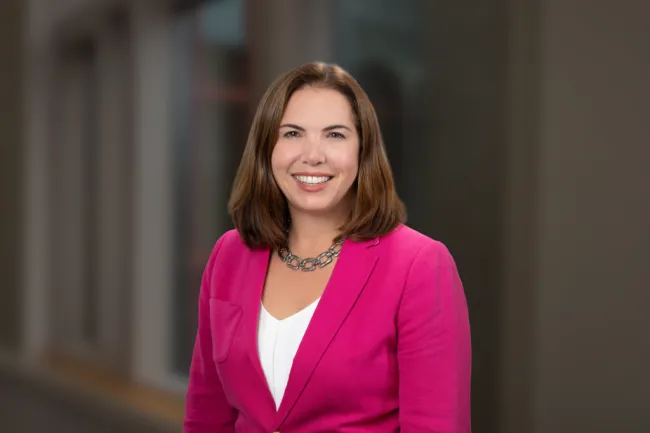
Erika Werner, MD, MPH, Chief Physician Executive at Tufts Medicine, President of the Tufts Medical Center Physicians Organization and Louis E. Phaneuf Teaching and Research Professor, Gynecology, Tufts University School of Medicine, has spent her career looking for ways to make healthcare better for patients and for the people who care for them.
Her path to medicine wasn’t exactly straightforward. An engineer by training, Dr. Werner explored healthcare consulting and cancer research before finding her calling in medicine. A single day during her third year of medical school changed everything: She caught her first baby during an obstetrics rotation and immediately knew she had found the right fit. Today, Dr. Werner brings that same curiosity and problem-solving mindset to her role as a physician leader. She spoke with us about what drew her to medicine, the importance of listening and what makes Tufts Medicine special.
1. You didn’t take the most direct path to becoming a physician. What drew you to medicine?
I grew up in Boston and knew early on that I loved math and science. I was in a special program in elementary school where they brought together girls from across my district who were good at math, and from that I learned that I wanted math and science to be part of my career. But I also really enjoy people.
I tried lots of different things. I have a master’s in civil and environmental engineering and did healthcare consulting for a while. At the end of the day, if you love math and science and you love people, medicine is a really good fit.
I thought I wanted to be an oncologist. I did prostate cancer research and thought I might become a cancer researcher studying the effects of the environment on health. That eventually led me to medical school. Then, at the very end of my third year, when you typically decide what you want to go into, I was on an obstetrics rotation at a small community hospital. I caught my first baby on my first day.
And I thought, I want to do this every day for the rest of my life. It was sort of as simple as that.
2. You’ve spent much of your career caring for women with high-risk pregnancies and leading in obstetrics and gynecology. What has kept you excited about medicine?
I like to solve problems. I think that's partly the engineer in me. The double-edged sword is that healthcare is really broken, and there is such an opportunity to make it better.
Initially, that was focused on high-risk pregnancy and then on the OBGYN department. Now I get to look at healthcare through a systems lens, from primary care to heart transplant. The problems are bigger and more diverse, but there are still so many opportunities to make things better. That’s what excites me.
One of the things I’m particularly interested in now is access. If you needed a colonoscopy this week and you called me, I could probably get your family member a colonoscopy within five minutes. If somebody called me for a neurology appointment while I was boarding an airplane, I could get them an appointment before the plane took off. Why can’t everybody have that access?
I think we should be able to create systems where every patient can get the care they need, at the time and location that works for them.
3. You often talk about the importance of listening to patients and to clinicians. Why is listening such an important part of good leadership?
I think it’s actually pretty simple. The root of great patient care is listening. And the root of having a great clinician culture is listening.
Patients want to know that you’re listening to what they say and that their treatment plan is informed by what’s important to them. Doctors want to know that the staffing plans, the rotations and even the equipment we’re buying are informed by what’s most important to them as they care for their patients.
I think we make it more complicated than it needs to be. The people who know where care is broken are the people who work in it every day. Physicians know what’s not working for their patients and what’s not working for them.
But listening has to lead to action. You need forums where clinicians and staff can raise their concerns and where those concerns can actually lead to substantial change. The longer I’m in this job, the less I have firsthand experience with all the pain points, I need others to share their experiences with me and my current team needs to carry that forward to change.
4. Was there a person or experience in your career that changed the way you think about being a physician or a physician leader?
When I had been at Tufts Medical Center for about a week, my phone rang. It was a leader just calling to check in. I eventually learned that he did that regularly. He spent several hours each week randomly calling physician leaders to see how things were going.
At first, I was totally intimidated by it. But I got used to having these conversations about what was going well, what wasn’t going well and what was bothering me that day. It wasn’t a formal check-in. It wasn’t a meeting that had been scheduled weeks in advance. It was just a conversation about what was on my mind.
That really stayed with me. It showed me something about the culture at Tufts Medicine, but it also showed me the value of catching people in the middle of their day and hearing what’s actually on the top of their mind rather than always relying on a formal agenda.
5. What makes Tufts Medicine a special place to practice medicine?
One of my favorite things about Tufts Medicine is how modest everybody is. There is amazing stuff going on here, and people are just doing it. They don’t necessarily talk about it.
You hear stories about a team going above and beyond for a patient, or physicians working together across specialties to make something possible that might not have been possible elsewhere. And for the people doing that work, it’s just what they do. They don't necessarily think of it as something extraordinary.
If I could wish one thing for the physician enterprise, it would be that our physicians would start talking about each other, outside of work and in their communities, and about all the amazing things their colleagues are doing. I think that carries more weight with people than any marketing we can do. There is so much going on here that is wonderful, and we should be talking about it.
Your voice matters here. At Tufts Medicine, listening to our clinicians is an important part of building a culture where people feel heard and ideas lead to meaningful change.