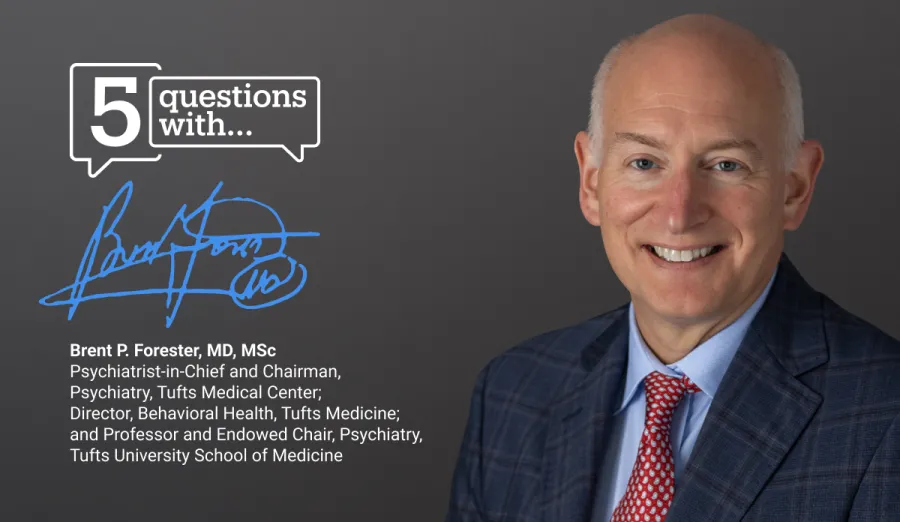
Dr. Brent Forester, a leading expert in geriatric psychiatry and dementia care, brings a wealth of experience and deep commitment to improving the lives of older adults. In this interview, he shares insights into his journey into psychiatry, the vital connection between primary care and behavioral health and his broader vision for enhancing care for individuals with dementia and other age-related conditions.
Dr. Forester, what inspired you to pursue a career in psychiatry?
This is a question I get a lot, and honestly, it's a combination of both genes and environment. I come from a family of psychiatrists. My father, who practiced until his passing just a month ago, and my grandfather, who practiced psychiatry and neurology in Brooklyn. Growing up, I had a front-row seat to my father's passion for his work and how much he loved his patients and the stories they shared.
I explored other paths before medical school, including working in management consulting, but it was my experience in a busy trauma-focused emergency room and on a psychiatry service that solidified my interest in medicine. What drew me to psychiatry was the intersection of brain and behavior—the way structural and biochemical changes in the brain show up in a person's behavior. That complexity and connection fascinated me.
I ultimately chose to specialize in geriatric psychiatry because it combines aspects of primary care, psychiatry and neurology. I find the stories of older adults and the challenge of managing both their mental and physical health deeply rewarding.
As an expert in geriatric psychiatry, what are the biggest challenges in caring for older adults with mental health conditions, especially in relation to dementia?
One of the biggest challenges is recognizing cognitive impairment in older adults, especially those with long-standing mental illnesses like depression or bipolar disorder. Many of these patients develop dementia as they age, but cognitive decline often goes unnoticed or is misdiagnosed. The key challenge is the lack of an integrated approach to care.
When I first started in this field, I was struck by how frequently older adults with severe mental illness had undiagnosed cognitive issues. They often did not receive appropriate care for dementia. This gap inspired my research into how mental illness and cognitive decline intersect, and how we can build care systems that address both issues simultaneously.
Tufts Medicine was recently selected to participate in the U.S. Early Detection Expansion Program launched by the Davos Alzheimer's Collaborative (DAC)—an initiative aimed at improving early detection of cognitive impairment and Alzheimer's disease in primary care settings. What's your vision for primary care's role in dementia care?
Tufts Medicine's participation in this new DAC Healthcare System Preparedness initiative represents a pivotal shift in dementia care—bringing early detection and management into primary care, where most patients already receive their health services. My vision for primary care aligns with the DAC's goals: timely detection, equitable access to diagnosis and seamless coordination between primary care clinicians and specialists.
Primary care is at the heart of dementia care. Early detection and ongoing management can profoundly impact patients and families. From my early career experience at Dartmouth, I saw how essential primary care clinicians are in identifying mental health concerns, including cognitive impairment. Given the limited number of specialists, many patients with dementia will never see one.
By equipping primary care clinicians with the tools and knowledge to screen for dementia, we can detect it earlier and manage it more effectively. Integrating cognitive and behavioral health assessment into routine primary care visits allows for early intervention, supports families and helps slow disease progression. Ultimately, primary care should serve as the frontline and ongoing medical home for dementia care, supported by a collaborative dementia care team and coordinated referral to specialists when needed.
You're an advocate for a closed-loop system in dementia care, where specialists and primary care work more closely together. What does this model look like in practice, and why is it so critical?
The idea of a closed-loop system is simple: integration. Dementia care can't just live in the specialist world—it has to be embedded in primary care. At Tufts Medicine, we are building a model where there is a continuous flow of information between primary care clinicians, specialists and dementia collaborative care teams.
In practice, a primary care clinician conducts initial screenings for dementia during routine wellness visits. If something is flagged, the care team—made up of social workers, geriatric nurse practitioners and dementia care navigators with a supervising dementia expert clinician (geriatric psychiatry and geriatric medicine)—steps in to support both the patient and clinician. The goal is to create an experience where primary care clinicians aren't managing complex dementia care alone, but also aren't waiting months for a specialist referral.
For patients who need more complex care, specialists (neurologists, geriatric psychiatrists, neuropsychologist), who are members of our Tufts Medicine Memory Care Center, will be engaged for further assessment and treatment, but the primary care clinician remains supported throughout the process. This closed-loop system improves outcomes and reduces wait times and fragmentation of care.
The Tufts Medicine Behavioral Health Hospital in Malden recently opened, how do you envision this facility contributing to the broader vision for mental healthcare access in our community?
The opening of the Tufts Medicine Behavioral Health Hospital in Malden is a significant milestone for Tufts Medicine. It enhances access to high-quality mental healthcare, particularly for patients who need more intensive services. The new facility strengthens our team-based care model by integrating and interdisciplinary team of behavioral healthcare specialists and primary care clinicians under one roof, ensuring patients have a seamless experience from diagnosis through ongoing care.
What excites me most is the hospital's focus on comprehensive, holistic care that addresses both mental and physical health needs. This ties into our broader vision of integrating care, where specialists in psychiatry, neurology and geriatric medicine work closely with primary care clinicians, nurses, psychologists and social workers to ensure patients receive the full spectrum of care and address a critical gap in mental health services.