“Minutes are muscle,” says Terri Fegan, Clinical Manager of Tufts Medicine Lowell General Hospital’s Heart and Vascular Center. “The longer a STEMI patient waits for treatment, the more damage is done to the heart muscle and the less chance of recovery.”
Studies show that cardiac deaths have declined significantly in the past 25 years thanks to a number of factors, from the decline of smoking to advances in heart surgery. But in some of those cases, the difference between life and death is access to highly coordinated and efficient process first responders call the “Chain of Survival.” The chain relies on a team of caregivers that can administer life-saving treatment on scene, followed by quick access to a hospital that can provide interventional cardiology procedures to reopen the artery.
For patients like Jason Hilberg of Boxboro, who suffered a heart attack in Lowell in January of 2023, these teams are life savers.
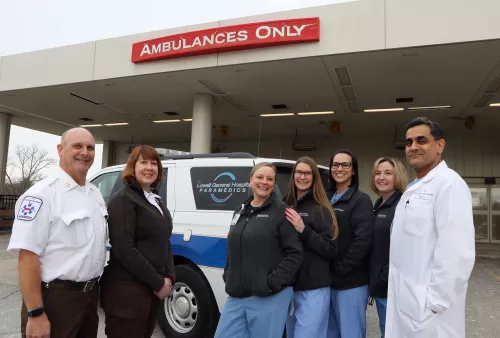
Lowell General’s paramedic service, which few Massachusetts communities have, provides Advanced life-saving treatment in the field, a step beyond what most ambulance EMTs can provide. Paramedics are trained to use semiautomatic defibrillation, which can provide a quicker shock of electricity to the heart, and take an ECG reading of the heart rhythm that is relayed to a cardiologist via cellphone.
“The ability of the paramedics to send us information in transit gives us time to prepare for the patient and get them directly into the Cath lab, saving valuable time,” Fegan said.
If the cardiologist is already on-site, the physician and support staff are typically waiting at the door of the Emergency Department to rush the patient to the Cath lab. Here, the cardiologist inserts a small catheter through an artery in the patient’s wrist or groin and opens the blocked artery using a small balloon or stent.
Called “door to balloon time,” the American Heart Association’s standard is to have the patient undergo this procedure within 90 minutes of arrival to the hospital, but thanks to the paramedics and a cardiology team with decades of experience, Lowell General’s average time is closer to 60 minutes.
For patients, those minutes can mean everything.