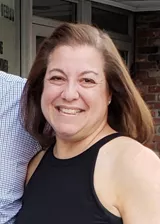
When Wendy Canty suffered a heart attack in 2018 at age 50, her recovery following quadruple bypass was not an easy one. It took two months post-procedure before the Framingham resident was able to return to her usual daily routine. But in July, 2020, Wendy once again began experiencing cardiac symptoms, including persistent lightheadedness and nausea. She underwent testing which revealed that three of her four bypasses were significantly blocked. Her cardiologist at Watch her story on WCVB.
As the Executive Director of The CardioVascular Center for Research and Innovation (CVCRI) at Tufts Medical Center, Interventional Cardiologist and Heart Failure Specialist Navin Kapur, MD, is deeply involved with developing and using novel technologies to improve patient care, safety and experience. When it became clear that Wendy would need a procedure to open up blocked arteries in her heart, Dr. Kapur offered her three different heart pump options, including the Impella ECP, as part of an early feasibility and safety study at Tufts MC.
“We are the only center in Boston actively doing trials like this,” said Dr. Kapur. “We want our patients to be among the first to benefit from the very latest medical and scientific advances to reduce risk and improve outcomes.”
As Dr. Kapur explained, this new innovation offered three distinct advantages for Wendy:
- The new technology features the first-ever expandable heart pump. It requires a small incision – one-half the size of the incision required by other heart pumps – so there is less bleeding. It’s also easier to put in and take out, so there are fewer vascular complications and less bruising.
- Once in place, the Impella ECP expands to become even larger than older heart pump models, providing as much, if not more, heart support.
- Because there is less bleeding, bruising and other complications with putting the heart pump in and taking it out, patients may have a shorter recovery time and less pain, so they can go home and get back on their feet quicker than when previous heart pump technologies are used.
Remembering her lengthy and difficult recovery following her first bypass surgery, Wendy was eager to try the Impella ECP. On November 2, 2020, Wendy became the first patient in New England and the fourth in the world to receive the Impella ECP heart pump, when Dr. Kapur successfully performed a complex cardiac catheterization procedure to place four new stents in her arteries.
The procedure went well. Wendy was walking the next day and was home and driving two days after the procedure. Less than a week later, she returned to work and was back to her regular exercise routine. And this time, Wendy did not experience any bruising, swelling or pain at the incision site.
“I’m extremely grateful for the quick recovery this time around,” said Wendy. “It was a much less difficult and scary experience for me and my family. And the incision was so small, the scar is already barely visible. Before long, you won’t see a thing!”