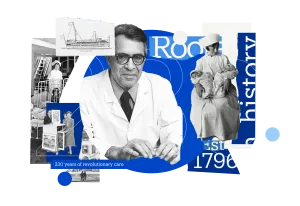
In 1796, Bostonians including Paul Revere and Samuel Adams helped establish the Boston Dispensary, the organization that would become Tufts Medical Center, a world-renowned academic medical center. Their commitment to caring for the community has guided us for more than 230 years. As America marks its 250th anniversary, we're celebrating our own history and reaffirming our commitment to advancing care through education, research and discovery.
230 years of revolutionary care
Rooted in history. Driven by innovation.

230 years of revolutionary care | Tufts Medical Center
230 years of revolutionary care | Tufts Medical Center


Born from revolution. Built for everyone after.
Twenty years after the Declaration of Independence, civic leaders including Paul Revere and Samuel Adams helped establish the Boston Dispensary. Their vision was groundbreaking: make medical care available to those who needed it most. More than 230 years later, that vision lives on. As we celebrate America's 250th anniversary, we're proud to care for every patient who entrusts us with their health while continuing to shape the future of medicine.
The beginning
The Boston Dispensary is established as the first permanent medical facility in New England and the third in the United States
The early years
- The Floating Hospital for Children was founded on a ship, where doctors believed the sea air of Boston Harbor would help the sick kids get well
- Tufts College Medical School opens at 188 Boylston Street in Boston
- The Boston Dispensary and Suffolk Dispensary become Tufts College Medical School's first teaching affiliates
Leaders in applied nutrition
- The Floating Hospital for Children began a hospital-based human milk collection for sick babies
- The Boston Dispensary opened the first nutrition clinic of its kind
- An artificial milk product is invented at the Floating Hospital for Children, later marketed as Similac
Innovation and partnership
- The Boston Dispensary begins an affiliation with the Floating Hospital for Children and in 1927 with Tufts University School of Medicine
- The Boston Dispensary, Boston Floating Hospital and Tufts College join to establish the New England Medical Center
Expansion of services
- The world's first experiment in group psychotherapy takes place at the Boston Dispensary
- 100-bed Pratt Clinic, the largest diagnostic clinic in the world, is constructed at the Boston Dispensary
- Early residency programs are established, marking the beginning of nearly a century of graduate medical education and physician training
Children's therapy
First children's playroom established to apply recreational therapy
Innovation in therapies
- Maurice Raben, MD, a pediatric endocrinologist at the Floating Hospital for Children, developed the first human growth hormone treatment by purifying hormones from human pituitary glands
- Immunosuppression therapy is developed to aid in successful organ transplants
Patient care innovations
- The Family Participation Unit is established at the Floating Hospital for Children, allowing parents to stay overnight with their children
- The country's first neighborhood health center is founded by Tufts University School of Medicine in Boston's Columbia Point housing project
Leading the way in care
- The world's first pediatric trauma center established at the Floating Hospital for Children
- Staff create the practice of case management, the first hospital to do so
Education and care
- The first, full-service private teaching hospital in Boston is created with the addition of a maternity service
- Neely House is established; first-of-its-kind bed and breakfast-style home within the hospital to host cancer patients and their families
- Rooftop helipad opened for pediatric and adult Medflight patients
Ranked #1
Tufts Medical Center becomes New England's leading heart transplant program, ranking #1 in transplant volume and outcomes
Celtics association
Paul Pierce Center for Minimally Invasive Surgery is established with funds from Boston Celtics great, Paul Pierce
A new name
Tufts-New England Medical Center is re-named Tufts Medical Center
Founding a new system
Tufts Medical Center becomes founding member of the Wellforce System
Level 1 Geriatric Emergency Department Accreditation
Tufts Medical Center is the first hospital in New England to receive the highest-level accreditation for excellence in older adult care
Tufts Children's Hospital
The Floating Hospital for Children is renamed Tufts Children's Hospital
Becoming Tufts Medicine
- Lowell General Hospital, MelroseWakefield Hospital, Tufts Medical Center and Tufts Medicine Care at Home unite under one name as Tufts Medicine; pediatric services continue as Tufts Medicine Pediatrics in collaboration with Boston Children's Hospital, creating an integrated academic health system
- Tufts Medical Center receives Magnet® recognition for nursing excellence
Tufts University-Tufts Medicine Research Enterprise
The Tufts University–Tufts Medicine (TU-TM) Research Enterprise unites the academic and research strengths of Tufts University with the clinical and research expertise of Tufts Medicine to accelerate discovery and translate innovation into better health outcomes
A new era in living donor transplantation
Tufts Medicine launches its Living Donor Liver Transplant Program, becoming a premier regional destination for organ transplantation

Pioneers in Care, Research + Medicine
Explore some of the people whose ideas, discoveries and leadership have helped move medicine forward.
By the numbers
Tufts Medical Center today
542,161
Outpatient visits in 2025
Top 8%
Nationally in NIH funding
56
Residency + fellowship programs
1,612
Births in 2025
46,315
Emergency department encounters in 2025
300+
Active clinical trials
900th
Heart transplant milestone
63
Heart transplants in 2025
200+
Physicians named Top Doctors, Boston Magazine 2026
230 years of medical firsts
New England’s #1 heart transplant program
More adult heart transplants than any other New England center since 2000. In 2024, 70 transplants—all with a 100% survival rate.
Only adult ECMO program in Boston
The only adult ECMO program in Boston with ELSO’s highest accreditation—with mobile capabilities to bring life-saving care directly to communities.
Pioneering brain + spine care
More than 1,700 complex neurosurgical procedures annually. Leaders in awake spinal surgery. First in Boston to provide new infusion therapies for Alzheimer’s patients.
Seeing the future of eye care
Our NEI-funded lab co-developed optical coherence tomography (OCT)—now the global standard for detecting and treating sight-threatening diseases.
Cancer care that goes further
Pioneered Gamma Knife radio surgery and oncoplastic breast surgery. One of the nation’s first programs for adolescent and young adult cancer patients. Among few Boston programs offering HIPEC—heated targeted chemotherapy delivered directly during surgery.
Transplant excellence
Heart, kidney and liver transplants with advanced minimally invasive techniques. Dedicated pathway for alcohol-related liver disease, among the only in New England. Recognized by the National Kidney Foundation’s Living Donor Circle of Excellence.
Care across every stage
~1,700 births annually, including the most complex maternal-fetal medicine cases. Groundbreaking research at the Woman, Mother and Baby Research Institute spanning nutrition, placenta health and intergenerational outcomes.
Training tomorrow's physicians
Principal teaching hospital for Tufts University School of Medicine. 52 residency and fellowship programs. More than 450 trainees learning what it means to put the patient first.


Honoring the past. Investing in what's next.
When the Boston Dispensary opened its doors in 1796, it was made possible by the generosity of donors who believed everyone deserved access to care.
More than 230 years later, philanthropy continues to fuel innovation, discovery and compassionate care at Tufts Medical Center.